Brain Fog Is a Real Problem — and the Best Creatine for Brain Fog May Help
If you've been searching for the best creatine for brain fog, here's the short answer:
Creatine monohydrate — 3 to 5g daily — is the most evidence-backed form for cognitive support. It works by helping your brain recycle energy (ATP) faster, which matters most when you're sleep-deprived, stressed, or running on empty.
Quick picks by need:
| Goal |
Best Form |
Daily Dose |
| Strongest evidence for brain fog |
Creatine monohydrate (micronized) |
3-5g |
| Brain fog + cognitive aging |
Creatine monohydrate |
5-10g |
| Worst sleep, fastest need |
Creatine monohydrate (acute high dose) |
0.35g/kg |
| Sensitive digestion |
Micronized monohydrate (try this first) |
3-5g |
| Prefer HCl for texture |
Creatine HCl (less evidence) |
1-2g |
Your brain is a massive energy consumer. It makes up just 2% of your body weight but burns roughly 20% of your total daily energy. When that energy supply dips — from poor sleep, chronic stress, or a low-creatine diet — mental clarity is often the first thing to go.
A 2024 meta-analysis of 16 studies found creatine supplementation can improve memory, attention, and information processing in adults. A separate 2024 study showed a single high dose improved cognitive performance in sleep-deprived people.
At Vida Life Science, we've spent years focused on one thing: getting nutrients into your cells where they actually work. Our expertise in advanced nutrient delivery — including liposomal technology — gives us a unique lens for evaluating which creatine forms genuinely support cellular energy.
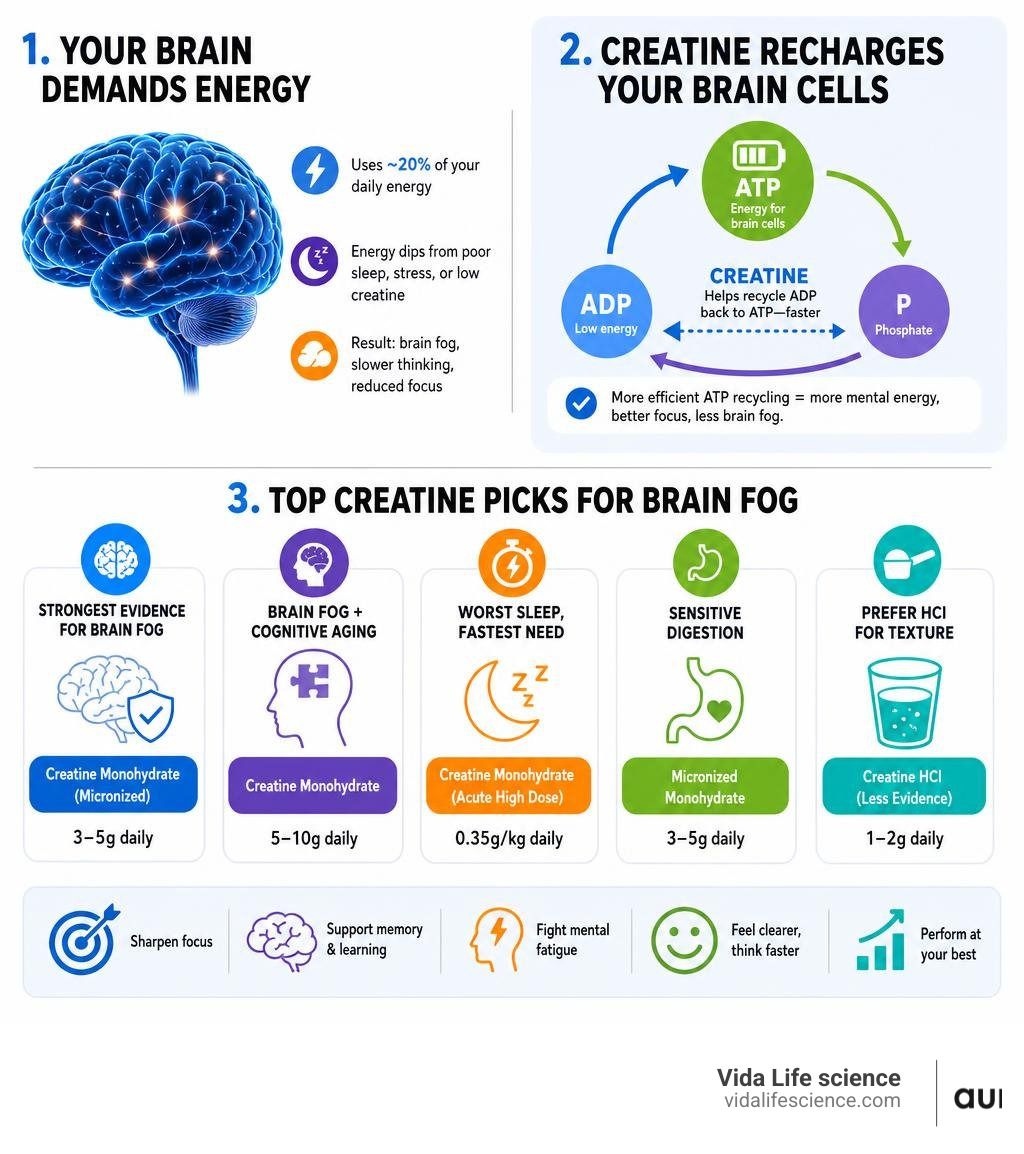
How Creatine Powers Brain Energy and Fights Mental Fatigue
Many people think of creatine strictly as a muscle-building supplement. However, your brain relies on the exact same cellular energy currency as your biceps: Adenosine Triphosphate (ATP). When your brain's ATP demands outpace its production, you experience what we commonly refer to as brain fog. Read more in our piece on Creatine for Brain Power and Mental Stamina.
The Science of ATP Recycling in Brain Cells
Once inside the brain, creatine binds with phosphate to form phosphocreatine. When energy demands spike, an enzyme called creatine kinase transfers this phosphate group directly to waiting ADP, regenerating ATP in milliseconds. This process acts like a rapid-response cellular battery backup, concentrated in the prefrontal cortex (decision-making, focus) and the hippocampus (learning and memory). For the deep academic dive, see this comprehensive review on creatine and brain function.
What Clinical Research Says About Creatine for Brain Fog
-
The 2024 Meta-Analysis: A systematic review of 16 RCTs involving nearly 500 participants showed creatine significantly improved short-term memory, reasoning, and attention.
-
The Sleep Deprivation Breakthrough: A single high dose of creatine (0.35 g/kg) improved processing speed by 16% to 29% and boosted working memory by roughly 10% in sleep-deprived individuals.
-
Cognitive Aging: Supplementing has been shown to support cognitive performance, processing speed, and memory retention in older adults as natural phosphocreatine levels decline.
Creatine doesn't act as a stimulant like caffeine — it supports your brain's natural energy reserves, making it most effective during acute metabolic stress. For a closer look at the trials, see Creatine for Cognitive Health: What Science Tells Us.
Choosing the Best Creatine for Brain Fog: Monohydrate vs. HCl
| Feature |
Creatine Monohydrate |
Creatine HCl |
| Scientific Evidence |
Outstanding (95%+ of all brain studies) |
Very minimal (mostly theoretical) |
| Solubility in Water |
Moderate (requires mixing or micronization) |
High (dissolves quickly) |
| Digestive Comfort |
Excellent (especially when micronized) |
Good (but highly acidic) |
| Brain Uptake Capacity |
Proven to cross the blood-brain barrier |
Assumed, but lacks direct human brain data |
| Cost Efficiency |
Extremely budget-friendly |
Considerably more expensive |
Creatine Monohydrate: The Gold Standard for Cognitive Support
Virtually every major study on brain health, memory, and sleep deprivation has used this specific form. If you are concerned about gritty texture or stomach mildness, choose a micronized monohydrate — the smaller particles improve solubility and are easier on your stomach.
Creatine HCl is bound to hydrochloric acid, which increases its solubility. However, from a cognitive standpoint, there is a catch: there are no direct human clinical trials showing Creatine HCl crosses the blood-brain barrier more effectively than monohydrate.
For those seeking the ultimate in nutrient absorption, liposomal creatine represents the cutting edge of delivery technology — wrapping creatine molecules in a protective layer of healthy lipids to shield the nutrient through digestion and facilitate superior cellular uptake without requiring massive doses. See our deeper breakdown in Liposomal Creatine & Cellular Energy.
Who Benefits Most and What to Expect
-
Vegetarians and Vegans: Because dietary creatine is only found in meat, poultry, and fish, plant-based eaters typically have 20% to 30% lower baseline creatine stores, and often see the most dramatic memory and processing speed gains.
-
The Chronically Sleep-Deprived: Shift workers, healthcare professionals, and new parents can use creatine as an energy cushion that keeps processing speed intact on minimal sleep.
-
High-Stress Professionals and Students: During intense cognitive demand, supplementation provides the extra stamina to maintain focus through long, demanding hours.
-
Women Navigating Perimenopause and Menopause: Hormonal shifts can impact brain energy metabolism; creatine offers non-hormonal metabolic support during these transitions.
See our related piece on Beyond Muscle Gains: The Surprising Brain Benefits of Creatine.
Timeline: How Long to Notice Results
-
Weeks 1 to 2: Subtle improvements in physical endurance and a slight reduction in afternoon mental fatigue.
-
Weeks 4 to 6: Brain phosphocreatine stores reach optimal saturation — most users report distinct improvement in word recall, sustained focus, and less daily brain fog.
Stacking Creatine with Other Nootropics
-
Citicoline (Cognizin): Supports acetylcholine production (focus and learning) and healthy brain cell membranes — a dual energy and signaling boost when paired with creatine.
-
Omega-3 Fatty Acids: Supports brain cell membrane fluidity.
-
Magnesium: Essential for over 300 biochemical reactions, including neurotransmitter regulation and sleep.
Safety and Daily Best Practices
-
Dosage: 5g to 10g daily is highly effective for long-term brain health, since brain uptake is slower than muscle uptake.
-
Hydration: Creatine draws water into your cells — drink plenty of water throughout the day.
-
Avoid the Bloat: Skip the traditional 20g/day loading phase if you experience minor bloating; a steady 5g daily dose reaches saturation, just a few weeks later.
Frequently Asked Questions
Does creatine give you a stimulant-like energy buzz?
No. Unlike caffeine, creatine doesn't give an immediate jolt — it works quietly by replenishing cellular ATP stores, giving you greater mental stamina rather than a rush.
Can you take creatine if you have kidney concerns?
Long-term creatine use doesn't harm kidney function in healthy individuals, though it can temporarily raise creatinine on routine blood work. Consult your doctor if you have pre-existing kidney conditions.
Is a loading phase required?
No — consistent daily dosing of 3 to 5g will safely saturate your tissue stores without the digestive issues of high-dose loading.
Conclusion
Beating brain fog isn't about temporary stimulant highs — it's a matter of giving your brain cells the fundamental energy resources they need. By supporting rapid ATP recycling, the best creatine for brain fog provides a clean, science-backed foundation for sustained focus, sharper memory, and mental resilience.
At Vida Life Science, our premium line of Aurora Nutrascience liposomal supplements is engineered specifically to overcome the absorption limits of traditional powders and capsules.
Shop Aurora Nutrascience Liposomal Creatine + GAA →
📩 Want more guides like this?
Get our free supplement guide — dosing breakdowns, ingredient science, and what to actually look for on a label — delivered straight to your inbox. Sign up here.
Related reading: Creatine Mental Effects · Liposomal Creatine & Cellular Energy


Unfog Your Mind: Best Creatine for Brain Fog and Cognitive Boost
🛒 Shop This Article: Aurora Nutrascience Liposomal Creatine + GAA — liposomal creatine monohydrate, the form discussed below.
Brain Fog Is a Real Problem — and the Best Creatine for Brain Fog May Help
If you've been searching for the best creatine for brain fog, here's the short answer:
Creatine monohydrate — 3 to 5g daily — is the most evidence-backed form for cognitive support. It works by helping your brain recycle energy (ATP) faster, which matters most when you're sleep-deprived, stressed, or running on empty.
Quick picks by need:
Your brain is a massive energy consumer. It makes up just 2% of your body weight but burns roughly 20% of your total daily energy. When that energy supply dips — from poor sleep, chronic stress, or a low-creatine diet — mental clarity is often the first thing to go.
A 2024 meta-analysis of 16 studies found creatine supplementation can improve memory, attention, and information processing in adults. A separate 2024 study showed a single high dose improved cognitive performance in sleep-deprived people.
At Vida Life Science, we've spent years focused on one thing: getting nutrients into your cells where they actually work. Our expertise in advanced nutrient delivery — including liposomal technology — gives us a unique lens for evaluating which creatine forms genuinely support cellular energy.
How Creatine Powers Brain Energy and Fights Mental Fatigue
Many people think of creatine strictly as a muscle-building supplement. However, your brain relies on the exact same cellular energy currency as your biceps: Adenosine Triphosphate (ATP). When your brain's ATP demands outpace its production, you experience what we commonly refer to as brain fog. Read more in our piece on Creatine for Brain Power and Mental Stamina.
The Science of ATP Recycling in Brain Cells
Once inside the brain, creatine binds with phosphate to form phosphocreatine. When energy demands spike, an enzyme called creatine kinase transfers this phosphate group directly to waiting ADP, regenerating ATP in milliseconds. This process acts like a rapid-response cellular battery backup, concentrated in the prefrontal cortex (decision-making, focus) and the hippocampus (learning and memory). For the deep academic dive, see this comprehensive review on creatine and brain function.
What Clinical Research Says About Creatine for Brain Fog
Creatine doesn't act as a stimulant like caffeine — it supports your brain's natural energy reserves, making it most effective during acute metabolic stress. For a closer look at the trials, see Creatine for Cognitive Health: What Science Tells Us.
Choosing the Best Creatine for Brain Fog: Monohydrate vs. HCl
Creatine Monohydrate: The Gold Standard for Cognitive Support
Virtually every major study on brain health, memory, and sleep deprivation has used this specific form. If you are concerned about gritty texture or stomach mildness, choose a micronized monohydrate — the smaller particles improve solubility and are easier on your stomach.
Creatine HCl and Alternative Forms
Creatine HCl is bound to hydrochloric acid, which increases its solubility. However, from a cognitive standpoint, there is a catch: there are no direct human clinical trials showing Creatine HCl crosses the blood-brain barrier more effectively than monohydrate.
For those seeking the ultimate in nutrient absorption, liposomal creatine represents the cutting edge of delivery technology — wrapping creatine molecules in a protective layer of healthy lipids to shield the nutrient through digestion and facilitate superior cellular uptake without requiring massive doses. See our deeper breakdown in Liposomal Creatine & Cellular Energy.
Who Benefits Most and What to Expect
See our related piece on Beyond Muscle Gains: The Surprising Brain Benefits of Creatine.
Timeline: How Long to Notice Results
Stacking Creatine with Other Nootropics
Safety and Daily Best Practices
Frequently Asked Questions
Does creatine give you a stimulant-like energy buzz?
No. Unlike caffeine, creatine doesn't give an immediate jolt — it works quietly by replenishing cellular ATP stores, giving you greater mental stamina rather than a rush.
Can you take creatine if you have kidney concerns?
Long-term creatine use doesn't harm kidney function in healthy individuals, though it can temporarily raise creatinine on routine blood work. Consult your doctor if you have pre-existing kidney conditions.
Is a loading phase required?
No — consistent daily dosing of 3 to 5g will safely saturate your tissue stores without the digestive issues of high-dose loading.
Conclusion
Beating brain fog isn't about temporary stimulant highs — it's a matter of giving your brain cells the fundamental energy resources they need. By supporting rapid ATP recycling, the best creatine for brain fog provides a clean, science-backed foundation for sustained focus, sharper memory, and mental resilience.
At Vida Life Science, our premium line of Aurora Nutrascience liposomal supplements is engineered specifically to overcome the absorption limits of traditional powders and capsules.
Shop Aurora Nutrascience Liposomal Creatine + GAA →
📩 Want more guides like this?
Get our free supplement guide — dosing breakdowns, ingredient science, and what to actually look for on a label — delivered straight to your inbox. Sign up here.
Related reading: Creatine Mental Effects · Liposomal Creatine & Cellular Energy