Why NAD+ and Resveratrol Work Better Together
NAD+ resveratrol combinations are gaining serious attention in the longevity and healthy aging space — and for good reason. Here's the quick version of what you need to know:
-
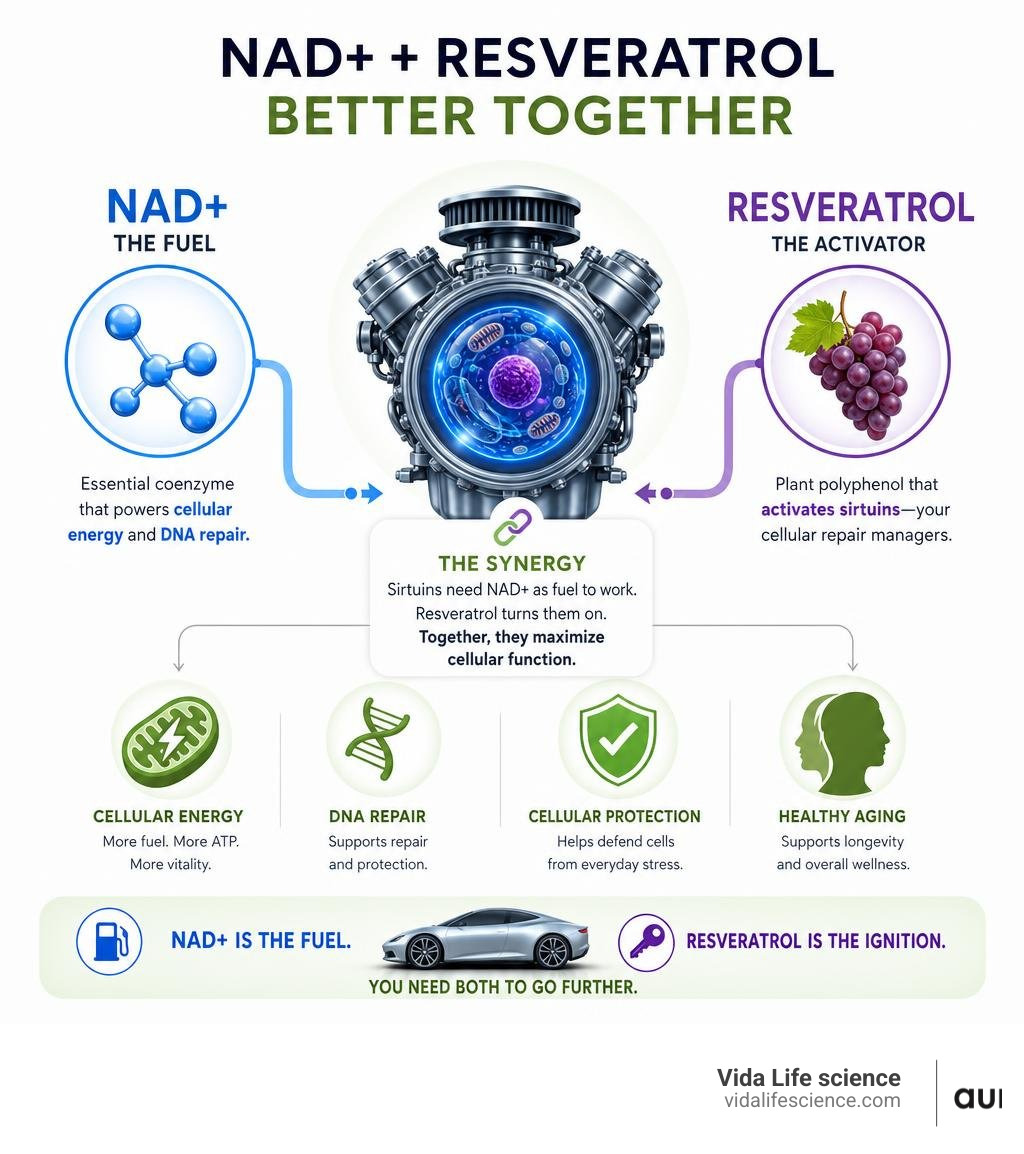
NAD+ is a coenzyme found in every cell of your body. It powers energy production and DNA repair. But its levels drop by up to 50% by age 40.
-
Resveratrol is a plant polyphenol (found in grapes and red wine) that activates proteins called sirtuins — the body's cellular repair managers.
-
The synergy: Sirtuins need NAD+ as fuel to function. Resveratrol acts as the accelerator. Without enough NAD+, resveratrol can't do its job. Without resveratrol, NAD+ has no "switch" to turn on sirtuin activity.
-
The result: Taking both together supports cellular energy, DNA repair, and healthy aging more effectively than either alone.
Think of it like a car engine: NAD+ is the fuel, and resveratrol is the ignition key. You need both.
Most people don't realize that standard supplements of either compound face a major hurdle: poor absorption. Resveratrol, for example, has less than 1% bioavailability in standard oral form. That means most of what you swallow never reaches your cells.
That's the problem this guide is designed to help you solve.
At Vida Lifescience, we're the exclusive US distributor of Aurora Nutrascience — a Canadian manufacturer specializing in phosphatidylcholine-based liposomal delivery technology, which is one of the most effective ways to address the bioavailability challenges of NAD+ resveratrol supplements.
What is NAD+ and Why Does It Decline?
To understand why the NAD+ resveratrol combination is so revolutionary, we first have to look at the powerhouse molecule: Nicotinamide Adenine Dinucleotide (NAD+).
Found in every single living cell, NAD+ is a critical coenzyme required for over 500 enzymatic reactions. Its most famous job is helping our mitochondria convert the food we eat into adenosine triphosphate (ATP)—the actual chemical fuel our cells use to perform every daily function, from contracting muscles to thinking.
Beyond energy production, NAD+ acts as a cellular housekeeper. It is a necessary substrate for PARPs (Poly ADP-Ribose Polymerases), which are specialized enzymes that detect and repair damaged DNA.
Unfortunately, our bodies do not have an infinite supply of this molecule. As we age, our natural NAD+ levels undergo a steady, steep decline. Research shows that by the time we reach our 40s, our NAD+ levels have dropped by approximately 50%. By age 60, that decline can reach up to 80%.
This progressive loss of NAD+ is a primary driver of age-related metabolic decline, persistent fatigue, slower physical recovery, and cognitive fog. To understand why this coenzyme is so vital to your daily well-being, you can read our comprehensive guide on low NAD+ levels: signs, causes and who's at risk.
Simply put, keeping your cellular levels topped up is one of the most proactive steps you can take for long-term vitality. Read more in What Is NAD+? The Essential Molecule for Energy and Vitality. According to a landmark scientific study on NAD+ decline, maintaining healthy NAD+ levels is closely tied to preserving mitochondrial health and preventing systemic cellular fatigue as we age.
The Science Behind the NAD+ Resveratrol Synergy
If NAD+ is the fuel that keeps our cells running, resveratrol is the high-performance tuning kit.
Resveratrol is a natural polyphenol antioxidant found in the skins of red grapes, blueberries, and Japanese knotweed. Resveratrol is famous for its unique ability to activate a family of proteins called sirtuins (specifically SIRT1 and SIRT3) — often called the "guardians of the genome" because they regulate cellular survival, manage inflammation, support healthy metabolism, and coordinate the clearance of cellular waste.
However, sirtuins have a major catch: they are entirely dependent on NAD+ to function.
This is where the magic of the NAD+ resveratrol synergy comes to life. Imagine your sirtuins are a high-performance sports car. Resveratrol acts as the driver stepping firmly on the gas pedal (accelerating sirtuin activity). But if the fuel tank is empty—meaning your cellular NAD+ levels are depleted due to age—stepping on the pedal does absolutely nothing.
Furthermore, resveratrol has been shown to upregulate an enzyme called NAMPT (nicotinamide phosphoribosyltransferase) — the rate-limiting enzyme in our body's natural NAD+ salvage pathway, which recycles used nicotinamide back into active NAD+. In other words, resveratrol doesn't just turn on sirtuins; it actually helps your cells rebuild and maintain their NAD+ pool more efficiently.
How NAD+ Resveratrol Combats Cellular Aging
As we age, our bodies accumulate "senescent cells"—often nicknamed "zombie cells." These are worn-out cells that have stopped dividing but refuse to die, secreting inflammatory molecules that damage surrounding healthy cells and accelerate aging.
The combination of NAD+ resveratrol targets these cellular trouble spots through multiple pathways:
-
Promoting Autophagy: Sirtuins activated by this synergistic duo help trigger autophagy—the body's natural cellular recycling program that identifies, breaks down, and clears away damaged proteins and senescent cell parts.
-
Preserving DNA Integrity: By keeping PARP enzymes fueled with NAD+ and sirtuins activated by resveratrol, your cells can repair double-stranded DNA breaks more rapidly.
-
Neutralizing Oxidative Stress: Resveratrol's potent antioxidant properties neutralize free radicals, reducing the oxidative stress that damages mitochondrial membranes and drains NAD+ reserves.
This multi-pathway cellular defense mechanism is supported by a growing body of literature, including a scientific study on sirtuins and longevity, which highlights how sirtuin activation directly protects tissues from age-related functional decline.
Maximizing the Benefits of NAD+ Resveratrol with Co-Factors
While the NAD+ resveratrol pairing is incredibly powerful on its own, modern longevity science shows we can amplify its effects even further by adding key cellular co-factors:
-
Urolithin A: A gut-derived metabolite that promotes mitophagy—the specific clearance and recycling of old, dysfunctional mitochondria.
-
CoQ10 (Coenzyme Q10): A vital compound located directly inside the mitochondrial membrane that facilitates the transfer of electrons during ATP production.
-
Alpha-Lipoic Acid (ALA): A versatile, universal antioxidant that helps regenerate other worn-out antioxidants (like Vitamin C and glutathione) while supporting healthy glucose metabolism — see our R-ALA dosage guide for details.
-
Green Tea Extract (EGCG): Provides robust protection against oxidative damage and works hand-in-hand with resveratrol to support cardiovascular health.
Overcoming Bioavailability Barriers with Liposomal Technology
Here is the inconvenient truth about longevity supplements: your digestive system is incredibly hostile to them.
Standard oral capsules and powders of NAD+ precursors and resveratrol suffer from notoriously poor bioavailability. Less than 1% of standard oral resveratrol actually reaches your bloodstream unchanged because your liver and gut enzymes rapidly metabolize it. Meanwhile, direct oral NAD+ is a large, highly unstable molecule that is easily broken down in the stomach before it can ever reach your tissues.
To get real results, you have to bypass these digestive barriers. That is where liposomal technology comes in.
A liposome is a microscopic, spherical bubble made of a double layer of phospholipids—the exact same material that makes up your own cellular membranes. By encapsulating sensitive nutrients like NAD+ precursors and resveratrol inside these protective lipid bubbles, several things happen: the phospholipid bilayer shields the actives from stomach acid, absorption through the lymphatic system largely bypasses the liver's destructive first-pass metabolism, and the liposomes can fuse directly with your cell membranes, releasing nutrients straight into the cells where they're needed.
At Vida Lifescience, we offer Aurora Nutrascience's advanced liposomal formulations, which utilize natural, non-GMO soy-free phospholipids to maximize absorption. Learn more in How to Boost NAD+ Levels Naturally.
NMN vs. Nicotinamide Riboside: Which Precursor is Best?
Because direct NAD+ molecules are too large to easily cross cell membranes, high-quality supplements typically use NAD+ precursors—smaller building blocks that your cells can readily absorb and convert into active NAD+.
The two most popular and heavily researched precursors are NMN (Nicotinamide Mononucleotide) and NR (Nicotinamide Riboside).
| Feature |
Nicotinamide Riboside (NR) |
Nicotinamide Mononucleotide (NMN) |
| Molecular Size |
Smaller molecule; easily enters cells via specific transporters. |
Slightly larger molecule; recent studies show direct transporters exist. |
| Clinical Track Record |
Extensively studied in human clinical trials with proven safety up to 1,000+ mg/day. |
Excellent results in animal models; human trials growing rapidly. |
| Regulatory Status |
Holds GRAS status in the US; widely available. |
Subject to ongoing regulatory discussions in the US, but popular in longevity communities. |
| Primary Benefit |
Exceptional at raising systemic NAD+ levels and combating physical fatigue. |
Highly effective for metabolic support, muscle recovery, and cellular repair. |
Both precursors are highly effective at elevating cellular NAD+ levels. Whichever precursor you choose, pairing it with liposomal delivery ensures that the maximum amount of the compound successfully reaches your cells.
For a deeper dive into how your body manages cellular repair, read our article on Glutathione NAD Cellular Support.
Frequently Asked Questions about NAD+ and Resveratrol
Are there any side effects of taking NAD+ and resveratrol together?
Both compounds have an excellent safety profile and are very well-tolerated by the vast majority of people. In clinical trials, daily doses of NAD+ precursors (up to 1,000 mg) and resveratrol (up to 500 mg) have shown no serious adverse effects.
However, some individuals taking standard, non-liposomal oral capsules in high doses may experience mild gastrointestinal upset. Choosing a liposomal formulation virtually eliminates this issue. Additionally, because resveratrol has mild anti-platelet (blood-thinning) properties, individuals taking prescription blood thinners or those scheduled for surgery should consult their healthcare provider first.
When is the best time of day to take these supplements?
We highly recommend taking your NAD+ booster and resveratrol in the morning. Your body's natural NAD+ production naturally peaks during the early hours of the day. Taking an NAD+ booster late in the evening can occasionally interfere with your ability to wind down and impact sleep quality.
Can you get enough resveratrol from diet alone?
The short answer is: unfortunately, no. A typical glass of red wine contains only about 1 to 2 milligrams of resveratrol. To reach a standard therapeutic daily dose of 250 to 500 milligrams, you would need to drink hundreds of bottles of red wine every single day. High-quality, concentrated supplementation is the only realistic way to experience the cellular longevity benefits of this powerful polyphenol.
Conclusion
The biological synergy of NAD+ resveratrol represents one of the most exciting and scientifically grounded chapters in modern longevity science. By combining the essential cellular "fuel" of NAD+ with the sirtuin-activating "accelerator" of resveratrol, you provide your body with a comprehensive toolkit to combat cellular aging, protect your DNA, and restore youthful energy levels.
However, a supplement is only as good as its ability to be absorbed. At Vida Lifescience, we bring you the gold standard of nutrient delivery through our exclusive partnership with Aurora Nutrascience. To find the perfect protocol for your wellness goals, explore our in-depth guide on NAD+ and Anti-Aging.
Shop Aurora Nutrascience NAD+/Resveratrol →
📩 Want more guides like this?
Get our free supplement guide — dosing breakdowns, ingredient science, and what to actually look for on a label — delivered straight to your inbox. Sign up here.


A Quick Start Guide to NAD+ and Resveratrol Synergy
🛒 Shop This Article: Aurora Nutrascience NAD+/Resveratrol — both compounds discussed below, together in one liposomal formula.
Why NAD+ and Resveratrol Work Better Together
NAD+ resveratrol combinations are gaining serious attention in the longevity and healthy aging space — and for good reason. Here's the quick version of what you need to know:
Think of it like a car engine: NAD+ is the fuel, and resveratrol is the ignition key. You need both.
Most people don't realize that standard supplements of either compound face a major hurdle: poor absorption. Resveratrol, for example, has less than 1% bioavailability in standard oral form. That means most of what you swallow never reaches your cells.
That's the problem this guide is designed to help you solve.
At Vida Lifescience, we're the exclusive US distributor of Aurora Nutrascience — a Canadian manufacturer specializing in phosphatidylcholine-based liposomal delivery technology, which is one of the most effective ways to address the bioavailability challenges of NAD+ resveratrol supplements.
What is NAD+ and Why Does It Decline?
To understand why the NAD+ resveratrol combination is so revolutionary, we first have to look at the powerhouse molecule: Nicotinamide Adenine Dinucleotide (NAD+).
Found in every single living cell, NAD+ is a critical coenzyme required for over 500 enzymatic reactions. Its most famous job is helping our mitochondria convert the food we eat into adenosine triphosphate (ATP)—the actual chemical fuel our cells use to perform every daily function, from contracting muscles to thinking.
Beyond energy production, NAD+ acts as a cellular housekeeper. It is a necessary substrate for PARPs (Poly ADP-Ribose Polymerases), which are specialized enzymes that detect and repair damaged DNA.
Unfortunately, our bodies do not have an infinite supply of this molecule. As we age, our natural NAD+ levels undergo a steady, steep decline. Research shows that by the time we reach our 40s, our NAD+ levels have dropped by approximately 50%. By age 60, that decline can reach up to 80%.
This progressive loss of NAD+ is a primary driver of age-related metabolic decline, persistent fatigue, slower physical recovery, and cognitive fog. To understand why this coenzyme is so vital to your daily well-being, you can read our comprehensive guide on low NAD+ levels: signs, causes and who's at risk.
Simply put, keeping your cellular levels topped up is one of the most proactive steps you can take for long-term vitality. Read more in What Is NAD+? The Essential Molecule for Energy and Vitality. According to a landmark scientific study on NAD+ decline, maintaining healthy NAD+ levels is closely tied to preserving mitochondrial health and preventing systemic cellular fatigue as we age.
The Science Behind the NAD+ Resveratrol Synergy
If NAD+ is the fuel that keeps our cells running, resveratrol is the high-performance tuning kit.
Resveratrol is a natural polyphenol antioxidant found in the skins of red grapes, blueberries, and Japanese knotweed. Resveratrol is famous for its unique ability to activate a family of proteins called sirtuins (specifically SIRT1 and SIRT3) — often called the "guardians of the genome" because they regulate cellular survival, manage inflammation, support healthy metabolism, and coordinate the clearance of cellular waste.
However, sirtuins have a major catch: they are entirely dependent on NAD+ to function.
This is where the magic of the NAD+ resveratrol synergy comes to life. Imagine your sirtuins are a high-performance sports car. Resveratrol acts as the driver stepping firmly on the gas pedal (accelerating sirtuin activity). But if the fuel tank is empty—meaning your cellular NAD+ levels are depleted due to age—stepping on the pedal does absolutely nothing.
Furthermore, resveratrol has been shown to upregulate an enzyme called NAMPT (nicotinamide phosphoribosyltransferase) — the rate-limiting enzyme in our body's natural NAD+ salvage pathway, which recycles used nicotinamide back into active NAD+. In other words, resveratrol doesn't just turn on sirtuins; it actually helps your cells rebuild and maintain their NAD+ pool more efficiently.
How NAD+ Resveratrol Combats Cellular Aging
As we age, our bodies accumulate "senescent cells"—often nicknamed "zombie cells." These are worn-out cells that have stopped dividing but refuse to die, secreting inflammatory molecules that damage surrounding healthy cells and accelerate aging.
The combination of NAD+ resveratrol targets these cellular trouble spots through multiple pathways:
This multi-pathway cellular defense mechanism is supported by a growing body of literature, including a scientific study on sirtuins and longevity, which highlights how sirtuin activation directly protects tissues from age-related functional decline.
Maximizing the Benefits of NAD+ Resveratrol with Co-Factors
While the NAD+ resveratrol pairing is incredibly powerful on its own, modern longevity science shows we can amplify its effects even further by adding key cellular co-factors:
Overcoming Bioavailability Barriers with Liposomal Technology
Here is the inconvenient truth about longevity supplements: your digestive system is incredibly hostile to them.
Standard oral capsules and powders of NAD+ precursors and resveratrol suffer from notoriously poor bioavailability. Less than 1% of standard oral resveratrol actually reaches your bloodstream unchanged because your liver and gut enzymes rapidly metabolize it. Meanwhile, direct oral NAD+ is a large, highly unstable molecule that is easily broken down in the stomach before it can ever reach your tissues.
To get real results, you have to bypass these digestive barriers. That is where liposomal technology comes in.
A liposome is a microscopic, spherical bubble made of a double layer of phospholipids—the exact same material that makes up your own cellular membranes. By encapsulating sensitive nutrients like NAD+ precursors and resveratrol inside these protective lipid bubbles, several things happen: the phospholipid bilayer shields the actives from stomach acid, absorption through the lymphatic system largely bypasses the liver's destructive first-pass metabolism, and the liposomes can fuse directly with your cell membranes, releasing nutrients straight into the cells where they're needed.
At Vida Lifescience, we offer Aurora Nutrascience's advanced liposomal formulations, which utilize natural, non-GMO soy-free phospholipids to maximize absorption. Learn more in How to Boost NAD+ Levels Naturally.
NMN vs. Nicotinamide Riboside: Which Precursor is Best?
Because direct NAD+ molecules are too large to easily cross cell membranes, high-quality supplements typically use NAD+ precursors—smaller building blocks that your cells can readily absorb and convert into active NAD+.
The two most popular and heavily researched precursors are NMN (Nicotinamide Mononucleotide) and NR (Nicotinamide Riboside).
Both precursors are highly effective at elevating cellular NAD+ levels. Whichever precursor you choose, pairing it with liposomal delivery ensures that the maximum amount of the compound successfully reaches your cells.
For a deeper dive into how your body manages cellular repair, read our article on Glutathione NAD Cellular Support.
Frequently Asked Questions about NAD+ and Resveratrol
Are there any side effects of taking NAD+ and resveratrol together?
Both compounds have an excellent safety profile and are very well-tolerated by the vast majority of people. In clinical trials, daily doses of NAD+ precursors (up to 1,000 mg) and resveratrol (up to 500 mg) have shown no serious adverse effects.
However, some individuals taking standard, non-liposomal oral capsules in high doses may experience mild gastrointestinal upset. Choosing a liposomal formulation virtually eliminates this issue. Additionally, because resveratrol has mild anti-platelet (blood-thinning) properties, individuals taking prescription blood thinners or those scheduled for surgery should consult their healthcare provider first.
When is the best time of day to take these supplements?
We highly recommend taking your NAD+ booster and resveratrol in the morning. Your body's natural NAD+ production naturally peaks during the early hours of the day. Taking an NAD+ booster late in the evening can occasionally interfere with your ability to wind down and impact sleep quality.
Can you get enough resveratrol from diet alone?
The short answer is: unfortunately, no. A typical glass of red wine contains only about 1 to 2 milligrams of resveratrol. To reach a standard therapeutic daily dose of 250 to 500 milligrams, you would need to drink hundreds of bottles of red wine every single day. High-quality, concentrated supplementation is the only realistic way to experience the cellular longevity benefits of this powerful polyphenol.
Conclusion
The biological synergy of NAD+ resveratrol represents one of the most exciting and scientifically grounded chapters in modern longevity science. By combining the essential cellular "fuel" of NAD+ with the sirtuin-activating "accelerator" of resveratrol, you provide your body with a comprehensive toolkit to combat cellular aging, protect your DNA, and restore youthful energy levels.
However, a supplement is only as good as its ability to be absorbed. At Vida Lifescience, we bring you the gold standard of nutrient delivery through our exclusive partnership with Aurora Nutrascience. To find the perfect protocol for your wellness goals, explore our in-depth guide on NAD+ and Anti-Aging.
Shop Aurora Nutrascience NAD+/Resveratrol →
📩 Want more guides like this?
Get our free supplement guide — dosing breakdowns, ingredient science, and what to actually look for on a label — delivered straight to your inbox. Sign up here.