1-MNA Capsules vs Liposomal Liquids: Which Stays Stable Longer?
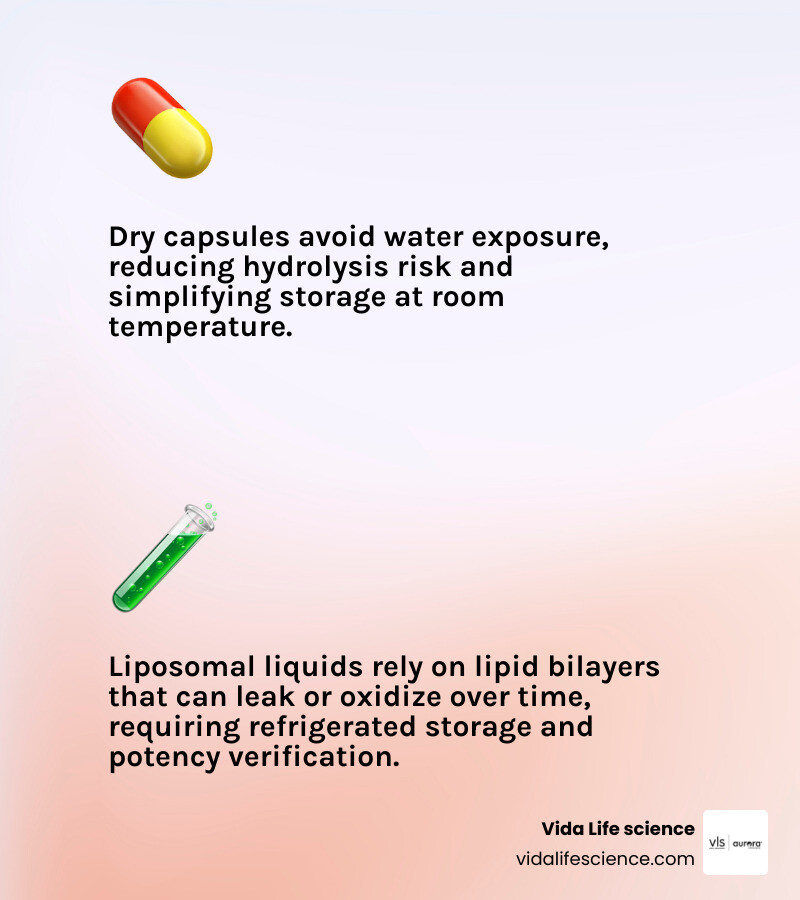
The short answer: Dry capsules avoid the water exposure that comes with a liposomal liquid, which may make them easier to store. Liposomal liquids add a protective carrier, but that carrier can leak or change as its lipids break down. Neither format has a proven shelf-life or absorption advantage for 1-MNA without product-specific testing. Check the label’s storage instructions and look for potency data through the expiration date.
At Vida Life Science, our experience with phosphatidylcholine-based liposomal supplements informs this guide. When evaluating the 1-MNA stability profile, capsules vs liposomal liquids present distinct advantages and vulnerabilities, from moisture sensitivity in dry powders to leakage and lipid oxidation in liquid formulations.
1-Methylnicotinamide (1-MNA) is an endogenous primary metabolite of nicotinamide (vitamin B3). In recent years, it has gained substantial interest across the nutraceutical and cellular longevity fields due to its role in supporting vascular endothelial integrity, modulating inflammatory pathways, and influencing cellular energy pathways.
Chemically, 1-MNA exists as a charged quaternary ammonium compound. Because it carries a permanent positive charge on its pyridine ring, 1-MNA is exceptionally hydrophilic and typically supplied as a crystalline chloride or halide salt. This chemical structure grants it high water solubility, but it also creates distinct formulation challenges. The salt exhibits pronounced hygroscopicity—meaning it readily pulls ambient moisture straight out of the atmosphere.
When developing stable oral dosage forms, formulation scientists must balance this innate water affinity against environmental degradation pathways. Exploring the science of advanced nutrient delivery reveals how different matrices shield sensitive active ingredients from early breakdown while maintaining maximum biological activity.
Crystalline Powder Characteristics vs Aqueous Phospholipid Bilayers
In dry capsule formats, 1-MNA is maintained in a crystalline or microcrystalline powder state. The crystalline lattice stabilizes the quaternary ammonium cation through strong electrostatic interactions with its counter-ion (such as chloride). Because no free water is present in a properly manufactured and sealed capsule, hydrolytic reactions remain dormant. The primary degradation risk for solid formulations is moisture ingress, which can dissolve the surface of the crystals, causing clumping, chemical instability, and capsule shell hardening or softening.
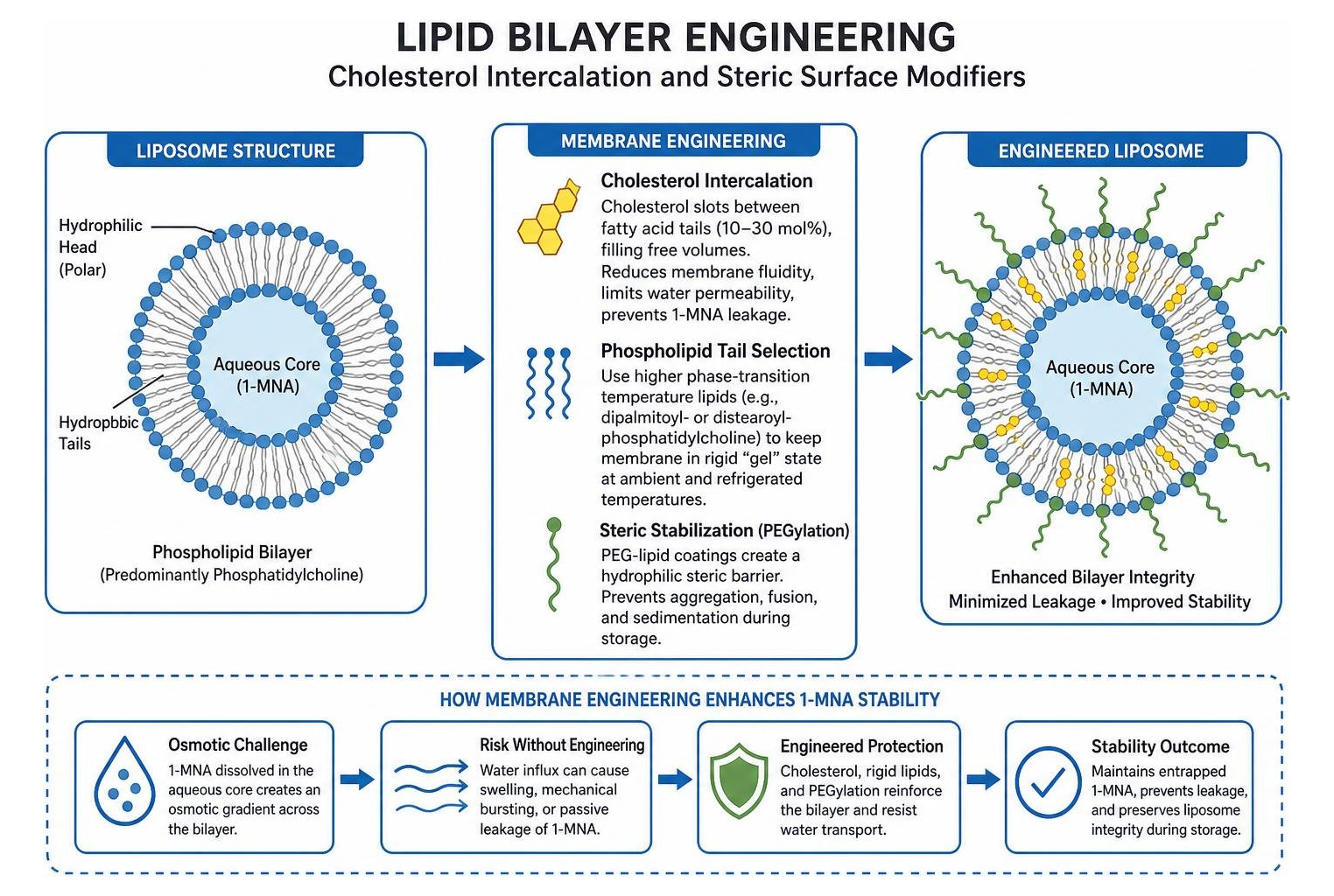
In liquid liposomal systems, the structural physics change completely (Nsairat et al., 2022). Because 1-MNA is water-soluble, it resides entrapped within the interior aqueous core of microscopic vesicles formed by phospholipid bilayers (predominantly phosphatidylcholine). Rather than resting in an inert dry matrix, dissolved 1-MNA ions establish an osmotic equilibrium across the bilayer membrane.
Maintaining this entrapment requires precise formulation: if the osmotic gradient between the inner core and the bulk external water phase becomes unbalanced, water rushes across the bilayer, leading to vesicle swelling, mechanical bursting, or passive active-ingredient leakage (Elnady et al., 2023). Comparative structural insights from a study on lipid nanocapsules and structural carriers illustrate how specialized lipid shells provide mechanical containment for sensitive molecules compared to unstructured solutions.
Membrane Engineering: Cholesterol and Surface Steric Modifiers
To stabilize liquid liposomes against premature leakage, formulators use membrane engineering techniques (Nsairat et al., 2022):
-
Cholesterol Intercalation: Formulators introduce cholesterol into the phospholipid bilayer at 10 to 30 mol%. Cholesterol molecules slot between the fatty acid tails of phosphatidylcholine, filling free volumes. This reduces membrane fluidity above the phase-transition temperature, limits water permeability, and prevents entrapped hydrophilic 1-MNA from diffusing out into the surrounding liquid.
-
Phospholipid Tail Selection: Using lipids with higher phase-transition temperatures (such as saturated distearoyl- or dipalmitoyl-phosphatidylcholine) ensures the membrane remains in a rigid "gel" state at ambient and refrigerated temperatures, minimizing structural breakdown.
-
Steric Stabilization (PEGylation): Adding hydrophilic polymer coatings, such as polyethylene glycol conjugated to lipid anchors (PEG-lipids), creates a protective steric barrier around each vesicle. This prevents liposomes from aggregating, fusing, or sedimenting during shelf storage.
Comparative 1-MNA Stability Profile: Capsules vs Liposomal Liquids
Evaluating the physical and chemical stability of 1-MNA across solid capsules and aqueous liposomal suspensions requires analyzing how each matrix handles environmental stress over time.
| Stability Parameter |
Dry Solid Capsules |
Liquid Liposomal Formulations |
| Primary Physical State |
Solid crystalline powder in polymer shell |
Aqueous suspension of nanoscopic lipid vesicles |
| Moisture Vulnerability |
High if seal fails (hygroscopic clumping) |
Inherent (surrounded by bulk water matrix) |
| Hydrolytic Degradation Risk |
Negligible in dry state |
Moderate to high for active and lipid bilayer |
| Thermal Sensitivity |
Low to moderate (stable at ambient room temp) |
High (requires refrigeration to limit lipid hydrolysis) |
| Oxidative Vulnerability |
Low (minimized via airtight packaging) |
High (unsaturated lipids prone to peroxidation) |
| Mechanical Fragility |
Extremely resilient to physical agitation |
Susceptible to shear stress, fusion, and leakage |
| Target Shelf-Life |
24 to 36 months at room temperature |
12 to 24 months (unopened, refrigerated) |
Analyzing the 1-MNA Stability Profile: Capsules vs Liposomal Liquids Under Environmental Stressors
When exposed to environmental stressors—such as shifting pH, atmospheric oxygen, ambient humidity, and UV light—the two delivery systems degrade through completely different pathways.
-
Atmospheric Humidity & Moisture: Standard vegetarian (HPMC) or gelatin capsules provide an effective physical barrier against ambient air. However, if exposed to excessive relative humidity, the hygroscopic 1-MNA salt draws water across the capsule wall, leading to liquefaction or localized chemical degradation. In contrast, liposomal liquids are already fully hydrated. Their primary risk is not moisture ingress, but hydrolytic cleavage of the ester bonds linking the fatty acids to the glycerol backbone of the phosphatidylcholine molecules, yielding free fatty acids and lyso-phospholipids that weaken the vesicle membrane.
-
Photo-Oxidation & Oxygen Exposure: Crystalline 1-MNA demonstrates strong resistance to direct photo-oxidation. In liposomes, however, unsaturated lipid tails in natural lecithin are vulnerable to lipid peroxidation when exposed to dissolved oxygen and light. This creates lipid peroxides that compromise vesicle integrity and accelerate active leakage. Robust formulation strategies, such as those detailed in research on single-vial liposomal formulation stability, highlight the necessity of amber glass packaging, inert nitrogen sparging, and antioxidant excipients (e.g., alpha-tocopherol) to mitigate oxidative decay.
-
pH Variations: Solid capsules remain inert until dissolved in digestive fluids. Liquid liposomes must maintain a strictly buffered physiological pH (typically 6.2 to 6.8) within the bottle. Deviations in pH accelerate both acid- and base-catalyzed lipid hydrolysis, disrupting vesicle structure long before consumption.
Long-Term Potency Retention, Hydrolysis, and Storage Protocols
For long-term potency retention, dry capsules have an inherent thermodynamic advantage. Without an aqueous reaction medium, crystalline 1-MNA does not undergo spontaneous hydrolysis or active transport leakage during storage. When packaged in blister packs or desiccant-equipped sealed bottles, dry capsules routinely maintain over 98% of their labeled potency for 24 to 36 months at ambient room temperatures (20°C to 25°C).
Liquid liposomes operate under kinetic constraints. Even with optimal membrane rigidity and antioxidant systems, water-soluble compounds like 1-MNA experience steady, baseline diffusion across fluid bilayers over time. Furthermore, slow hydrolysis of the lipid bilayer can gradually reduce encapsulation efficiency.
As noted in a comprehensive review of liposome drug delivery and regulatory aspects, maintaining the physical and chemical shelf-life of liquid formulations requires strict cold-chain management (2°C to 8°C). Keeping liquid liposomes refrigerated slows molecular movement, suppresses lipid ester bond hydrolysis, and helps prevent passive 1-MNA leakage.
Bioavailability, Drug Release Kinetics, and Pharmacokinetics
While dry capsules offer straightforward shelf stability, evaluating their therapeutic utility requires looking at their absorption kinetics, mucosal permeability, and systemic circulation profile.
Capsule dissolution relies entirely on passive gastrointestinal mechanics. Once swallowed, the polymer shell dissolves in gastric acid within 10 to 20 minutes, releasing the raw 1-MNA salt into the stomach. As a charged quaternary amine, free 1-MNA cannot readily pass through cell membranes by passive diffusion. It relies heavily on specific carrier-mediated transport systems (such as organic cation transporters, or OCTs) along the intestinal epithelium. Saturation of these transporters can create an upper limit on absorption efficiency for standard unencapsulated salts.
In contrast, our advanced liquid liposomal supplements utilize a lipid vehicle engineered to interact directly with the intestinal mucosal barrier. Rather than relying solely on active protein transport, intact nano-liposomes can facilitate cellular uptake through direct membrane fusion, pinocytosis, or enterocyte-mediated endocytosis.
Pharmacokinetic Impact and the 1-MNA Stability Profile: Capsules vs Liposomal Liquids
The pharmacokinetic profile of 1-MNA depends on how well the delivery format protects the molecule and facilitates its uptake into systemic circulation:
-
Peak Plasma Concentration (Cmax): Free 1-MNA from capsules yields a classic absorption curve governed by gastric emptying rates and transporter kinetics. Well-formulated liposomal liquids often demonstrate a faster initial rise in plasma levels, as sub-150 nm vesicles begin absorbing rapidly across the upper intestinal mucosa.
-
Area Under the Curve (AUC): Total systemic exposure (plasma AUC) reflects net bioavailability. When liposomes shield 1-MNA from intestinal clearance mechanisms and facilitate transcellular transport, a higher percentage of the active compound reaches circulation intact. This enhanced uptake mirrors mechanisms detailed in our NAD supplement insights and cellular longevity guide, where lipid carrier architectures help optimize overall systemic exposure.
-
Circulation Half-Life & Clearance: Because 1-MNA is water-soluble, renal excretion clears free circulating molecules relatively quickly. Lipid carrier delivery helps modulate these rapid clearance spikes, providing smoother, more sustained plasma concentrations.
Gastrointestinal Protection, First-Pass Bypass, and Cellular Uptake
The gastrointestinal tract presents a challenging chemical environment for orally administered nutrients:
-
Gastric Acid Defense: Unprotected liposomes made of simple, low-purity lecithins can aggregate or break down when exposed to stomach acid (pH 1.5 to 2.0) and bile salts. High-grade liposomes engineered with structured phosphatidylcholine and cholesterol maintain their bilayer integrity through the stomach, shielding the entrapped 1-MNA until it reaches the absorptive surface of the small intestine.
-
Chylomicron Mimicry and Lymphatic Uptake: Large or specialized lipid assemblies can enter the lymphatic system via enterocyte packaging into chylomicrons. Bypassing the portal vein avoids immediate first-pass hepatic metabolism, allowing un-cleared active compounds to circulate directly into systemic vascular beds.
-
Enhanced Cellular Fusion: Phosphatidylcholine vesicles share structural identity with human cell membranes. Upon reaching target tissues, the liposomal shell fuses with outer cell membranes, delivering 1-MNA directly into the intracellular cytoplasm.
Manufacturing Reproducibility, Quality Control, and In Silico Modeling
Manufacturing stability into both formats requires distinct engineering controls and validated analytical standards.
Capsule manufacturing focuses on solid-state controls: humidity management in the cleanroom, powder blend uniformity, and shell moisture equilibria. Facilities producing products in our clinical capsule line standards monitor water activity closely to prevent powder cake formation and maintain long-term stability.
Liposomal liquid manufacturing is considerably more complex. It requires advanced particle-engineering technologies, such as microfluidic hydrodynamic focusing or high-pressure micro-fluidization. Operating under high shear pressures, these platforms break phospholipid sheets into uniform, single-bilayer vesicles (small unilamellar vesicles, or SUVs) while maintaining high entrapment of dissolved 1-MNA.
Scale-Up Parameters and Encapsulation Efficiency
Maintaining batch-to-batch consistency in commercial liposomal liquids requires tracking several key analytical attributes:
-
Particle Size & Polydispersity Index (PDI): Measured via Dynamic Light Scattering (DLS), therapeutic liposomal suspensions aim for a tight particle size distribution (typically 50 to 150 nm) with a PDI below 0.2. Broad distributions mean mixed populations of small and large vesicles, which increases the risk of fusion, precipitation, and active leakage over time.
-
Encapsulation Efficiency (EE%): EE% quantifies the percentage of total 1-MNA successfully trapped inside the vesicles versus free active compound in the surrounding liquid. High-efficiency systems achieve entrapment yields above 80%, keeping the bulk of the active compound shielded within the lipid bilayers.
-
Zeta Potential: Measuring the electrostatic charge on the vesicle surface indicates colloidal stability. Formulations with zeta potentials greater than +30 mV or more negative than -30 mV provide natural electrostatic repulsion, preventing vesicles from clustering into larger, unstable aggregates.
Solid dosage forms, by comparison, undergo stability validation under established protocols (Wempe et al., 2016), such as an investigation into solid dosage stability and storage conditions, confirming that sealed, dry formats resist degradation without requiring complex colloidal stabilizers.
Computational Stability Predictions and Quality Assurance
Modern nutraceutical engineering relies on computational modeling to forecast shelf-life and optimize lipid matrices:
-
Molecular Dynamics (MD) Simulations: Formulators use all-atom and coarse-grained in silico simulations to model how 1-MNA interacts with different phospholipid mixtures. By simulating membrane free energy, these models calculate how easily the hydrophilic molecule might diffuse across various bilayer compositions, helping scientists fine-tune cholesterol ratios before running pilot production runs.
-
Arrhenius Accelerated Degradation Protocols: Stability teams place finished products in environmental chambers under elevated temperatures and relative humidity (e.g., 40°C at 75% RH for capsules; 25°C for liquids). Measuring degradation rates across multiple temperatures allows formulators to use Arrhenius kinetics to calculate accurate real-time shelf-life projections.
-
HPLC-UV and Mass Spectrometry Assays: Validated high-performance liquid chromatography (HPLC) methods monitor intact 1-MNA concentrations alongside potential degradation byproducts, ensuring products consistently meet their labeled potency through their expiration date.
How does storage temperature affect liposomal liquid 1-MNA compared to dry capsules?
Dry capsules are chemically stable at controlled room temperature (20°C to 25°C), provided they are kept in a dry environment away from direct sunlight. Liquid liposomal 1-MNA formulations are much more sensitive to heat; ambient temperatures accelerate both the hydrolysis of the phospholipid bilayer and the diffusion of the active compound out of the vesicles. To preserve physical structure, prevent leakage, and slow lipid oxidation, liquid liposomes should be stored in the refrigerator (2°C to 8°C).
Does encapsulation efficiency drop over time in aqueous liposomal 1-MNA?
Yes. Over time, water-soluble molecules in an aqueous suspension experience slow, passive diffusion across the lipid membrane toward thermodynamic equilibrium. Even in well-formulated, cholesterol-stabilized liposomes, a small percentage of entrapped 1-MNA gradually moves from the inner aqueous core into the external liquid phase over a 12-to-24-month period. Maintaining proper refrigeration and a balanced osmotic formulation significantly reduces this leakage rate.
Why choose liposomal liquid 1-MNA if dry capsules offer longer room-temperature shelf stability?
While capsules offer convenient, room-temperature shelf stability, unencapsulated 1-MNA is a charged salt that relies on saturable intestinal transport proteins for absorption. Liquid liposomal 1-MNA encapsulates the nutrient within phospholipid membranes that mimic human cell walls, supporting uptake via direct mucosal pathways, endocytosis, and reduced gastrointestinal irritation. The decision comes down to balancing shelf-life convenience against advanced delivery performance.
Conclusion
Understanding the distinct stability profiles of 1-MNA capsules and liposomal liquids allows you to make informed choices based on your specific lifestyle, storage preferences, and health goals.
Dry capsules remain the gold standard for straightforward, shelf-stable storage at room temperature. They protect hygroscopic 1-MNA from ambient moisture through crystalline lattice packing and protective outer shells, delivering dependable, long-term potency without requiring refrigeration.
Liquid liposomes, on the other hand, trade simple storage for advanced delivery mechanics. By encapsulating 1-MNA within structured phospholipid bilayers, high-grade liquid formulations protect the active compound through digestive transit, support gentle gastrointestinal delivery, and enhance cellular uptake.
At Vida Life Science, our mission is to deliver high-quality, scientifically sound supplements backed by transparent manufacturing and strict quality control. Discover what makes advanced liposomal engineering superior for nutrient absorption and explore how purposeful delivery technology can support your daily wellness routine.
References
Nsairat H, Khater D, Sayed U, Odeh F, Al Bawab A, Alshaer W. "Liposomes: structure, composition, types, and clinical applications.." Heliyon, 2022. PMCID PMC9118483. Rana E. Elnady, Maha M. Amin, Mohamed Y. Zakaria. "A review on lipid-based nanocarriers mimicking chylomicron and their potential in drug delivery and targeting infectious and cancerous diseases." AAPS Open, 2023. DOI 10.1186/s41120-023-00080-x. Wempe MF, Oldland A, Stolpman N, Kiser TH. "Stability of dronabinol capsules when stored frozen, refrigerated, or at room temperature.." American journal of health-system pharmacy : AJHP : official journal of the American Society of Health-System Pharmacists, 2016. PMID 27385703. Wenxue Mao, Fan Wu, Robert J. Lee, Weigen Lu, Jianxin Wang. "<p>Development of a stable single-vial liposomal formulation for vincristine</p>." International Journal of Nanomedicine, 2019. DOI 10.2147/ijn.s205276.


The Science of Staying Stable: 1-MNA Capsules vs Liposomal Liquids
1-MNA Capsules vs Liposomal Liquids: Which Stays Stable Longer?
The short answer: Dry capsules avoid the water exposure that comes with a liposomal liquid, which may make them easier to store. Liposomal liquids add a protective carrier, but that carrier can leak or change as its lipids break down. Neither format has a proven shelf-life or absorption advantage for 1-MNA without product-specific testing. Check the label’s storage instructions and look for potency data through the expiration date.
At Vida Life Science, our experience with phosphatidylcholine-based liposomal supplements informs this guide. When evaluating the 1-MNA stability profile, capsules vs liposomal liquids present distinct advantages and vulnerabilities, from moisture sensitivity in dry powders to leakage and lipid oxidation in liquid formulations.
Molecular Properties and Formulation Chemistry of 1-MNA
1-Methylnicotinamide (1-MNA) is an endogenous primary metabolite of nicotinamide (vitamin B3). In recent years, it has gained substantial interest across the nutraceutical and cellular longevity fields due to its role in supporting vascular endothelial integrity, modulating inflammatory pathways, and influencing cellular energy pathways.
Chemically, 1-MNA exists as a charged quaternary ammonium compound. Because it carries a permanent positive charge on its pyridine ring, 1-MNA is exceptionally hydrophilic and typically supplied as a crystalline chloride or halide salt. This chemical structure grants it high water solubility, but it also creates distinct formulation challenges. The salt exhibits pronounced hygroscopicity—meaning it readily pulls ambient moisture straight out of the atmosphere.
When developing stable oral dosage forms, formulation scientists must balance this innate water affinity against environmental degradation pathways. Exploring the science of advanced nutrient delivery reveals how different matrices shield sensitive active ingredients from early breakdown while maintaining maximum biological activity.
Crystalline Powder Characteristics vs Aqueous Phospholipid Bilayers
In dry capsule formats, 1-MNA is maintained in a crystalline or microcrystalline powder state. The crystalline lattice stabilizes the quaternary ammonium cation through strong electrostatic interactions with its counter-ion (such as chloride). Because no free water is present in a properly manufactured and sealed capsule, hydrolytic reactions remain dormant. The primary degradation risk for solid formulations is moisture ingress, which can dissolve the surface of the crystals, causing clumping, chemical instability, and capsule shell hardening or softening.
In liquid liposomal systems, the structural physics change completely (Nsairat et al., 2022). Because 1-MNA is water-soluble, it resides entrapped within the interior aqueous core of microscopic vesicles formed by phospholipid bilayers (predominantly phosphatidylcholine). Rather than resting in an inert dry matrix, dissolved 1-MNA ions establish an osmotic equilibrium across the bilayer membrane.
Maintaining this entrapment requires precise formulation: if the osmotic gradient between the inner core and the bulk external water phase becomes unbalanced, water rushes across the bilayer, leading to vesicle swelling, mechanical bursting, or passive active-ingredient leakage (Elnady et al., 2023). Comparative structural insights from a study on lipid nanocapsules and structural carriers illustrate how specialized lipid shells provide mechanical containment for sensitive molecules compared to unstructured solutions.
Membrane Engineering: Cholesterol and Surface Steric Modifiers
To stabilize liquid liposomes against premature leakage, formulators use membrane engineering techniques (Nsairat et al., 2022):
Comparative 1-MNA Stability Profile: Capsules vs Liposomal Liquids
Evaluating the physical and chemical stability of 1-MNA across solid capsules and aqueous liposomal suspensions requires analyzing how each matrix handles environmental stress over time.
Analyzing the 1-MNA Stability Profile: Capsules vs Liposomal Liquids Under Environmental Stressors
When exposed to environmental stressors—such as shifting pH, atmospheric oxygen, ambient humidity, and UV light—the two delivery systems degrade through completely different pathways.
Long-Term Potency Retention, Hydrolysis, and Storage Protocols
For long-term potency retention, dry capsules have an inherent thermodynamic advantage. Without an aqueous reaction medium, crystalline 1-MNA does not undergo spontaneous hydrolysis or active transport leakage during storage. When packaged in blister packs or desiccant-equipped sealed bottles, dry capsules routinely maintain over 98% of their labeled potency for 24 to 36 months at ambient room temperatures (20°C to 25°C).
Liquid liposomes operate under kinetic constraints. Even with optimal membrane rigidity and antioxidant systems, water-soluble compounds like 1-MNA experience steady, baseline diffusion across fluid bilayers over time. Furthermore, slow hydrolysis of the lipid bilayer can gradually reduce encapsulation efficiency.
As noted in a comprehensive review of liposome drug delivery and regulatory aspects, maintaining the physical and chemical shelf-life of liquid formulations requires strict cold-chain management (2°C to 8°C). Keeping liquid liposomes refrigerated slows molecular movement, suppresses lipid ester bond hydrolysis, and helps prevent passive 1-MNA leakage.
Bioavailability, Drug Release Kinetics, and Pharmacokinetics
While dry capsules offer straightforward shelf stability, evaluating their therapeutic utility requires looking at their absorption kinetics, mucosal permeability, and systemic circulation profile.
Capsule dissolution relies entirely on passive gastrointestinal mechanics. Once swallowed, the polymer shell dissolves in gastric acid within 10 to 20 minutes, releasing the raw 1-MNA salt into the stomach. As a charged quaternary amine, free 1-MNA cannot readily pass through cell membranes by passive diffusion. It relies heavily on specific carrier-mediated transport systems (such as organic cation transporters, or OCTs) along the intestinal epithelium. Saturation of these transporters can create an upper limit on absorption efficiency for standard unencapsulated salts.
In contrast, our advanced liquid liposomal supplements utilize a lipid vehicle engineered to interact directly with the intestinal mucosal barrier. Rather than relying solely on active protein transport, intact nano-liposomes can facilitate cellular uptake through direct membrane fusion, pinocytosis, or enterocyte-mediated endocytosis.
Pharmacokinetic Impact and the 1-MNA Stability Profile: Capsules vs Liposomal Liquids
The pharmacokinetic profile of 1-MNA depends on how well the delivery format protects the molecule and facilitates its uptake into systemic circulation:
Gastrointestinal Protection, First-Pass Bypass, and Cellular Uptake
The gastrointestinal tract presents a challenging chemical environment for orally administered nutrients:
Manufacturing Reproducibility, Quality Control, and In Silico Modeling
Manufacturing stability into both formats requires distinct engineering controls and validated analytical standards.
Capsule manufacturing focuses on solid-state controls: humidity management in the cleanroom, powder blend uniformity, and shell moisture equilibria. Facilities producing products in our clinical capsule line standards monitor water activity closely to prevent powder cake formation and maintain long-term stability.
Liposomal liquid manufacturing is considerably more complex. It requires advanced particle-engineering technologies, such as microfluidic hydrodynamic focusing or high-pressure micro-fluidization. Operating under high shear pressures, these platforms break phospholipid sheets into uniform, single-bilayer vesicles (small unilamellar vesicles, or SUVs) while maintaining high entrapment of dissolved 1-MNA.
Scale-Up Parameters and Encapsulation Efficiency
Maintaining batch-to-batch consistency in commercial liposomal liquids requires tracking several key analytical attributes:
Solid dosage forms, by comparison, undergo stability validation under established protocols (Wempe et al., 2016), such as an investigation into solid dosage stability and storage conditions, confirming that sealed, dry formats resist degradation without requiring complex colloidal stabilizers.
Computational Stability Predictions and Quality Assurance
Modern nutraceutical engineering relies on computational modeling to forecast shelf-life and optimize lipid matrices:
Frequently Asked Questions About 1-MNA Formulations
How does storage temperature affect liposomal liquid 1-MNA compared to dry capsules?
Dry capsules are chemically stable at controlled room temperature (20°C to 25°C), provided they are kept in a dry environment away from direct sunlight. Liquid liposomal 1-MNA formulations are much more sensitive to heat; ambient temperatures accelerate both the hydrolysis of the phospholipid bilayer and the diffusion of the active compound out of the vesicles. To preserve physical structure, prevent leakage, and slow lipid oxidation, liquid liposomes should be stored in the refrigerator (2°C to 8°C).
Does encapsulation efficiency drop over time in aqueous liposomal 1-MNA?
Yes. Over time, water-soluble molecules in an aqueous suspension experience slow, passive diffusion across the lipid membrane toward thermodynamic equilibrium. Even in well-formulated, cholesterol-stabilized liposomes, a small percentage of entrapped 1-MNA gradually moves from the inner aqueous core into the external liquid phase over a 12-to-24-month period. Maintaining proper refrigeration and a balanced osmotic formulation significantly reduces this leakage rate.
Why choose liposomal liquid 1-MNA if dry capsules offer longer room-temperature shelf stability?
While capsules offer convenient, room-temperature shelf stability, unencapsulated 1-MNA is a charged salt that relies on saturable intestinal transport proteins for absorption. Liquid liposomal 1-MNA encapsulates the nutrient within phospholipid membranes that mimic human cell walls, supporting uptake via direct mucosal pathways, endocytosis, and reduced gastrointestinal irritation. The decision comes down to balancing shelf-life convenience against advanced delivery performance.
Conclusion
Understanding the distinct stability profiles of 1-MNA capsules and liposomal liquids allows you to make informed choices based on your specific lifestyle, storage preferences, and health goals.
Dry capsules remain the gold standard for straightforward, shelf-stable storage at room temperature. They protect hygroscopic 1-MNA from ambient moisture through crystalline lattice packing and protective outer shells, delivering dependable, long-term potency without requiring refrigeration.
Liquid liposomes, on the other hand, trade simple storage for advanced delivery mechanics. By encapsulating 1-MNA within structured phospholipid bilayers, high-grade liquid formulations protect the active compound through digestive transit, support gentle gastrointestinal delivery, and enhance cellular uptake.
At Vida Life Science, our mission is to deliver high-quality, scientifically sound supplements backed by transparent manufacturing and strict quality control. Discover what makes advanced liposomal engineering superior for nutrient absorption and explore how purposeful delivery technology can support your daily wellness routine.
References
Nsairat H, Khater D, Sayed U, Odeh F, Al Bawab A, Alshaer W. "Liposomes: structure, composition, types, and clinical applications.." Heliyon, 2022. PMCID PMC9118483. Rana E. Elnady, Maha M. Amin, Mohamed Y. Zakaria. "A review on lipid-based nanocarriers mimicking chylomicron and their potential in drug delivery and targeting infectious and cancerous diseases." AAPS Open, 2023. DOI 10.1186/s41120-023-00080-x. Wempe MF, Oldland A, Stolpman N, Kiser TH. "Stability of dronabinol capsules when stored frozen, refrigerated, or at room temperature.." American journal of health-system pharmacy : AJHP : official journal of the American Society of Health-System Pharmacists, 2016. PMID 27385703. Wenxue Mao, Fan Wu, Robert J. Lee, Weigen Lu, Jianxin Wang. "<p>Development of a stable single-vial liposomal formulation for vincristine</p>." International Journal of Nanomedicine, 2019. DOI 10.2147/ijn.s205276.