Why Getting Your R-Lipoic Acid Dosage Right Matters
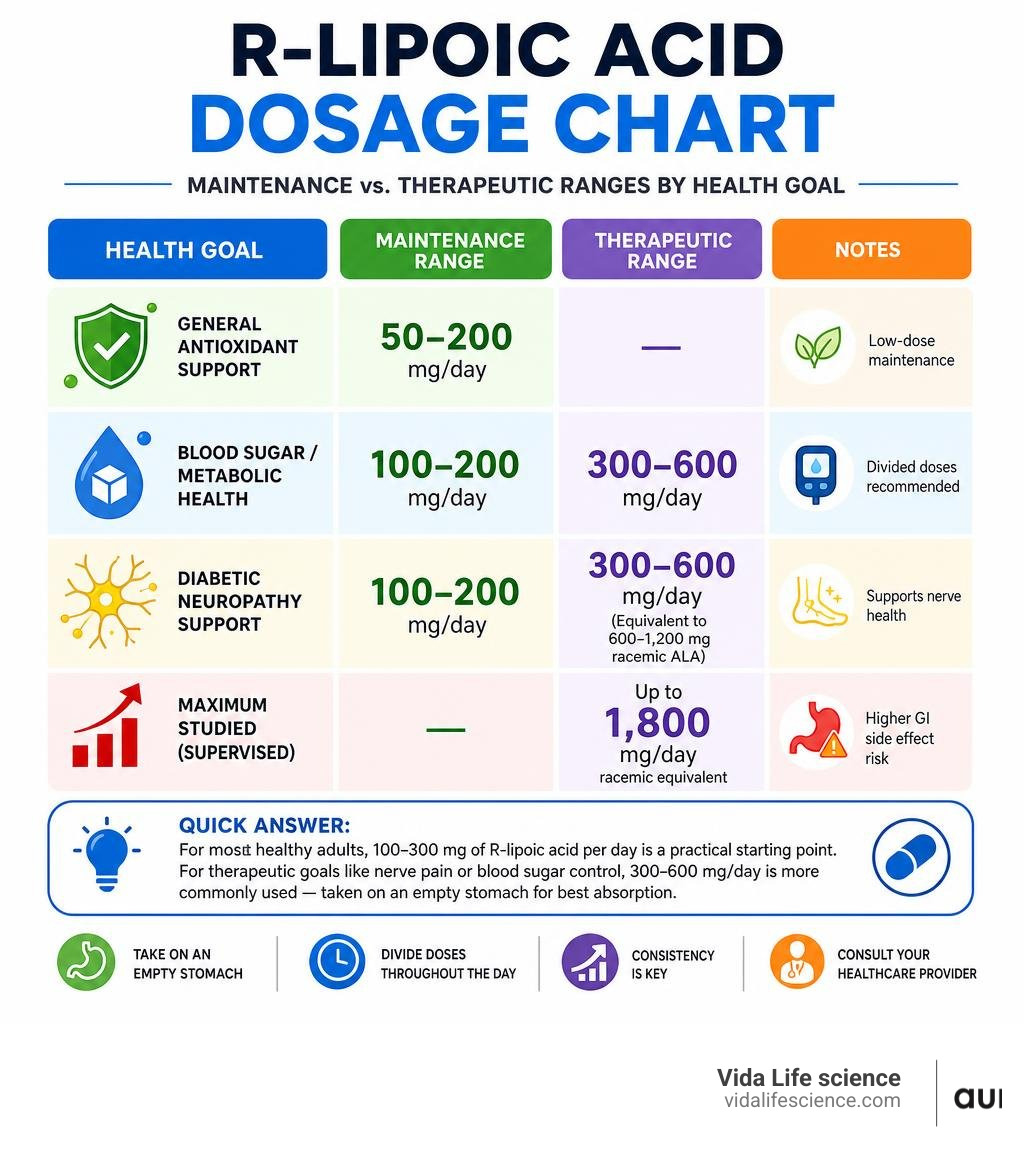
The right r lipoic acid dosage depends on your health goal — here's a quick reference:
| Goal |
Typical R-ALA Dose |
Notes |
| General antioxidant support |
50–200 mg/day |
Low-dose maintenance |
| Blood sugar / metabolic health |
300–600 mg/day |
Divided doses recommended |
| Diabetic neuropathy support |
300–600 mg/day |
Equivalent to 600–1,200 mg racemic ALA |
| Maximum studied (supervised) |
Up to 1,800 mg/day racemic equivalent |
Higher GI side effect risk |
Quick answer: For most healthy adults, 100–300 mg of R-lipoic acid per day is a practical starting point. For therapeutic goals like nerve pain or blood sugar control, 300–600 mg/day is more commonly used — taken on an empty stomach for best absorption.
R-lipoic acid is the form your body actually makes and uses. It's the biologically active enantiomer of alpha-lipoic acid (ALA) — a compound your mitochondria rely on to produce energy. Unlike the cheaper racemic supplements (which are a 50/50 mix of active R and inactive S forms), pure R-lipoic acid delivers only what your cells can actually use.
But here's where people get confused: more is not always better. Research shows that 600 mg/day of racemic ALA — roughly equivalent to 300 mg of pure R-ALA — was as effective as higher doses in several key clinical trials. Getting the dose wrong means either wasting money or risking side effects like nausea or blood sugar dips.
At Vida Life Science, we've spent years working with advanced nutrient delivery systems — including liposomal and bioavailability-enhanced formats — and the question of r lipoic acid dosage is one we help customers navigate every day. In this guide, we'll walk you through exactly how to find the dose that fits your goals.
Understanding R-Lipoic Acid vs. Racemic ALA
To understand why your r lipoic acid dosage is structured the way it is, we need to look at a bit of basic biochemistry.
Alpha-lipoic acid exists in two distinct forms, known as enantiomers or optical isomers. These are mirror images of each other, much like your left and right hands:
-
R-alpha-lipoic acid (R-ALA): This is the naturally occurring, biologically active isomer. It is the only form synthesized endogenously by human cells and incorporated directly into mitochondrial enzyme complexes (like pyruvate dehydrogenase).
-
S-alpha-lipoic acid (S-ALA): This is a synthetic byproduct of chemical manufacturing. It does not exist in nature, and your cells cannot readily utilize it as a cofactor.
Most standard, budget-friendly supplements on the market contain a 50/50 "racemic" mixture of both forms, simply labeled as "Alpha-Lipoic Acid." If you buy a 600 mg capsule of standard ALA, you are actually getting only 300 mg of the active R-form and 300 mg of the synthetic S-form.
| Feature |
R-Lipoic Acid (R-ALA) |
Racemic ALA (R,S-ALA) |
| Biological Activity |
100% active; native to human mitochondria |
Only 50% active; contains synthetic S-form |
| Bioavailability |
40% to 50% higher peak plasma levels |
Lower relative absorption of the active form |
| Stability |
Highly heat-sensitive; prone to polymerization |
More stable (the S-form acts as a chemical buffer) |
| Typical Daily Dose |
100 mg to 600 mg |
300 mg to 1,800 mg |
While the S-enantiomer in racemic mixtures is not inherently toxic, it acts as chemical "junk mail" in your bloodstream. In fact, some pharmacokinetic studies suggest that the S-isomer can actually compete with the R-isomer for cellular absorption pathways, potentially lowering the overall efficacy of the active nutrient.
However, pure R-ALA has a major physical drawback: stability. In its pure, unstabilized state, R-lipoic acid is highly sensitive to heat and moisture. If left in a warm room, it can quickly polymerize—a process where the molecules bind together into a plastic-like substance that your digestive tract cannot break down or absorb.
To solve this, manufacturers use specialized delivery technologies. Some bind the R-ALA to a sodium salt (creating Sodium R-lipoate, or Na-RALA), while others utilize advanced liposomal encapsulation to protect the delicate molecules from heat, light, and stomach acid.
Choosing a highly bioavailable R-form allows you to achieve the same—or superior—clinical benefits at a much lower milligram dose than standard racemic mixtures. You can read more about these differences in this comprehensive guide on R-Lipoic Acid Bioavailability and Benefits.
Determining Your Optimal R Lipoic Acid Dosage
Finding your ideal daily intake depends heavily on your primary health objective. Because R-lipoic acid is highly bioavailable, a standard r lipoic acid dosage is typically lower than the doses used in historical clinical trials, which predominantly utilized racemic mixtures.
Standard R Lipoic Acid Dosage for General Antioxidant Support
If you are taking R-lipoic acid as a preventive measure to support healthy aging, combat daily oxidative stress, and optimize mitochondrial energy production, a lower maintenance dose is ideal.
-
Recommended Range: 50 mg to 200 mg per day.
-
How it works: Lipoic acid is often referred to as the "captain of antioxidants." It has the unique ability to operate in both water- and fat-soluble cellular environments. More importantly, it recycles other critical antioxidants—such as Vitamin C, Vitamin E, CoQ10, and glutathione—after they have been depleted.
-
Why low doses work: For general cellular defense, you do not need to saturate your tissues. A daily dose of 100 mg of high-quality R-ALA provides ample cofactor support for your mitochondria without overloading your metabolic pathways.
Therapeutic R Lipoic Acid Dosage for Neuropathy and Blood Sugar Control
For individuals managing chronic metabolic conditions, diabetic peripheral neuropathy, or insulin resistance, a higher, therapeutic dose is required to achieve noticeable clinical outcomes.
-
Recommended Range: 300 mg to 600 mg of R-ALA per day (often split into two daily doses of 150 mg to 300 mg).
-
Targeting Diabetic Neuropathy: Up to 50% of individuals with diabetes eventually develop peripheral neuropathy, characterized by burning pain, numbness, and tingling in the hands and feet. Clinical trials have repeatedly demonstrated that oral administration of 600 mg/day of lipoic acid (racemic equivalent) significantly reduces these symptoms. Interestingly, a landmark five-week study of 181 patients showed that a 600 mg/day dose was just as effective as higher doses of 1,200 mg and 1,800 mg, but with far fewer gastrointestinal side effects.
-
Supporting Glucose Metabolism: A 2018 systematic review and meta-analysis of 20 randomized controlled trials (enrolling 1,245 subjects with metabolic disorders) confirmed that daily lipoic acid supplementation (ranging from 200 to 1,800 mg/day) successfully lowered fasting blood glucose, reduced insulin resistance, and improved long-term HbA1c markers. Because R-ALA is twice as potent by weight as the racemic mixture, a 300 mg daily dose of pure R-ALA is often the optimal starting point for glycemic control.
To explore the clinical trials behind these therapeutic applications in greater detail, refer to this detailed review on Clinical Evidence on Neuropathy and Nerve Support.
How to Take R-Lipoic Acid for Maximum Absorption
Taking the correct milligram dose is only half the battle; how and when you take it determines how much actually reaches your cells.
To get the absolute most out of your supplement, keep these practical guidelines in mind:
-
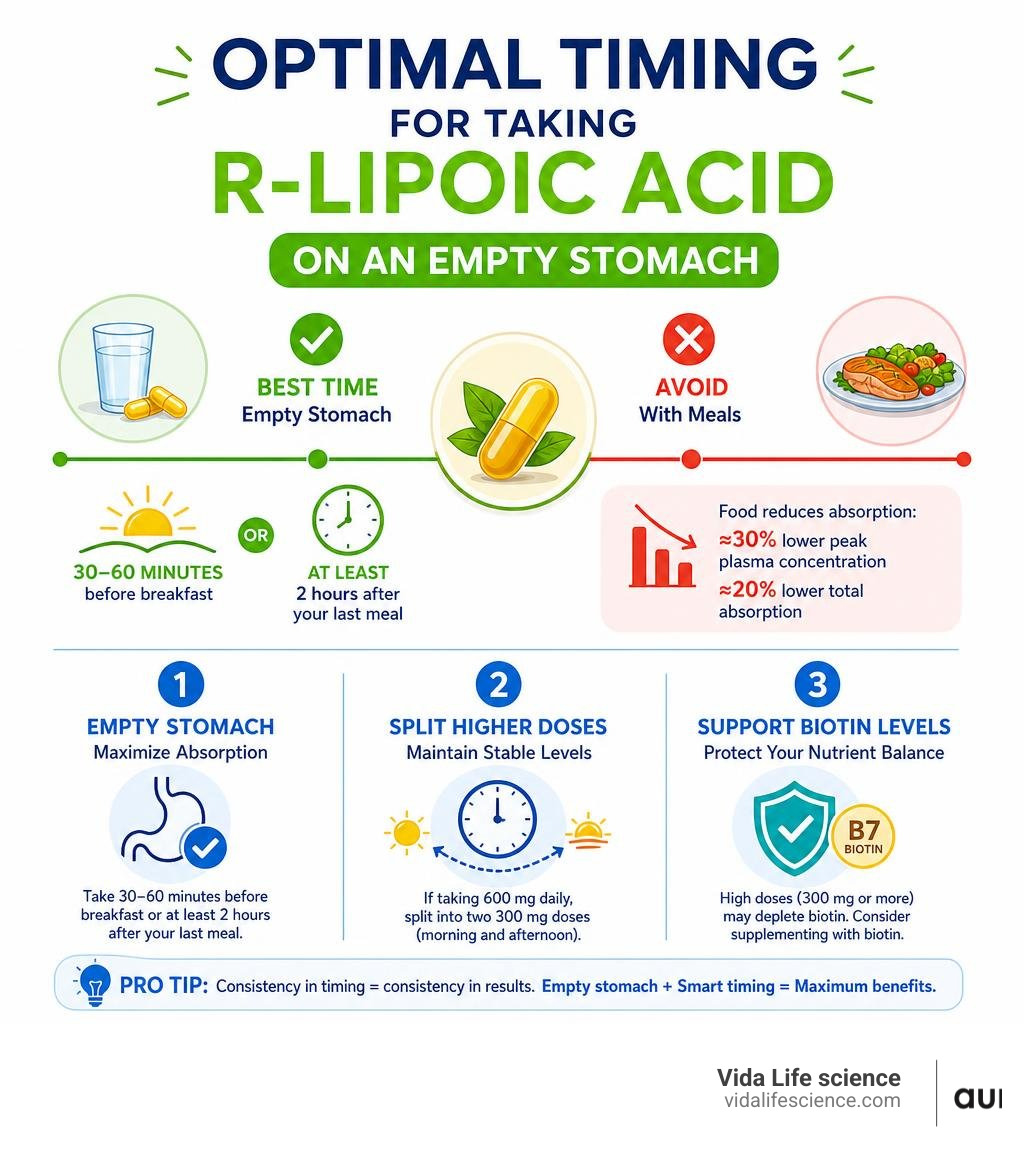
Always take it on an empty stomach: Lipoic acid absorption is heavily compromised by food. Clinical data shows that taking lipoic acid with a meal decreases peak plasma concentrations by approximately 30% and reduces total absorption by about 20%. For optimal results, take your dose 30 to 60 minutes before breakfast, or at least 2 hours after your last meal.
-
Split your doses if taking higher amounts: R-lipoic acid has a incredibly short half-life in the human body—typically around 30 minutes. If you are taking a therapeutic dose of 600 mg daily, splitting it into two 300 mg doses (one in the morning and one in the afternoon) keeps blood levels more stable throughout the day.
-
Be mindful of Biotin depletion: Because lipoic acid shares a structural similarity with biotin (Vitamin B7), high doses of lipoic acid can compete with biotin for transport across cell membranes. If you are taking a therapeutic R-ALA dose of 300 mg or more daily for several months, it is highly recommended to supplement with a separate biotin capsule to prevent a deficiency.
-
Ensure Thiamine adequacy: Lipoic acid works hand-in-hand with Thiamine (Vitamin B1) to convert glucose into cellular energy. If you are thiamine-deficient, high-dose lipoic acid cannot do its job effectively and can even exacerbate certain metabolic issues. This is particularly important for heavy alcohol consumers or elderly individuals, who are at a higher risk for low thiamine levels.
Safety, Side Effects, and Drug Interactions
R-lipoic acid has an excellent safety profile, with human clinical trials showing high tolerability even at doses up to 1,800 mg/day. However, like any active metabolic compound, it carries potential risks and drug interactions that require careful management.
-
Gastrointestinal Distress: The most common side effects are mild and include heartburn, nausea, and abdominal discomfort. These side effects are highly dose-dependent. While they are rare at maintenance doses (under 200 mg), the risk increases significantly at therapeutic doses of 1,200 mg/day or higher.
-
Hypoglycemia Risk: Because R-lipoic acid is highly effective at increasing insulin sensitivity and moving glucose out of the bloodstream, it can cause blood sugar levels to drop. If you are currently taking insulin or oral anti-diabetic medications (like metformin), combining them with a high r lipoic acid dosage could trigger hypoglycemia (low blood sugar). It is crucial to monitor your blood glucose closely and consult your healthcare provider to adjust your medication dosages if necessary.
-
Thyroid Hormone Interaction: Lipoic acid may inhibit the conversion of thyroxine (T4) to triiodothyronine (T3), the active form of thyroid hormone. If you take thyroid medication (such as levothyroxine), you should space your R-lipoic acid dose at least 2 to 4 hours away from your thyroid medication and have your thyroid hormone levels (TSH, free T3, free T4) monitored regularly.
-
Insulin Autoimmune Syndrome (Hirata’s Disease): This is an extremely rare genetic condition, primarily reported in individuals of East Asian descent, where supplemental lipoic acid triggers an autoimmune reaction against the body's own insulin, resulting in severe hypoglycemia. While exceptionally rare, any sudden episodes of dizziness, sweating, or shaking after starting R-ALA should be addressed immediately.
-
Heavy Metal Chelation: Lipoic acid is a mild chelator of heavy metals. While this can be beneficial for detoxification, it also means it can bind to essential dietary minerals (like iron, zinc, and magnesium). To avoid this, take your mineral supplements at a different time of day than your R-lipoic acid.
For a deeper dive into how different demographics tolerate high doses, you can read the published medical literature on Tolerability and Safety in Special Populations.
Frequently Asked Questions About R-Lipoic Acid
How long does it take for R-lipoic acid to work?
It depends on what you are treating. For nerve-related discomfort (like burning or tingling), clinical trials show that subjective improvements often begin within 2 to 4 weeks of consistent daily use. For deeper metabolic changes, such as improvements in insulin sensitivity, fasting blood glucose, or HbA1c markers, expect to wait between 4 to 12 weeks of daily supplementation to see measurable shifts in your lab work.
Is R-lipoic acid safe to take every day?
Yes, daily use of R-lipoic acid is safe and has been studied in clinical settings for durations of up to one year without significant safety concerns. However, if you are taking a high therapeutic dose (above 300–400 mg/day), many clinical practitioners recommend taking periodic "cycles" or breaks (e.g., taking it for 3 months, then taking a 1 to 2-week break) to allow your body's natural antioxidant systems to self-regulate.
What is the difference between R-ALA and Na-RALA?
Pure R-ALA is highly unstable and easily degrades or polymerizes when exposed to heat or stomach acid. Na-RALA (Sodium R-lipoate) is R-lipoic acid bound to a sodium salt. This chemical bond stabilizes the molecule, preventing polymerization and allowing it to survive shelf-storage. Na-RALA is highly water-soluble and can achieve up to 3 times higher peak blood concentrations than unstabilized, pure R-lipoic acid.
Conclusion
Finding your perfect r lipoic acid dosage comes down to matching your daily intake to your specific physiological needs. Whether you are seeking a 100 mg daily dose for proactive cellular defense or a robust 600 mg daily protocol to support nerve health and glucose metabolism, the delivery system you choose makes all the difference.
Because standard oral capsules are easily degraded by stomach acid and poorly absorbed when taken with food, maximizing bioavailability is key to avoiding wasted nutrients and stomach upset.
At Vida Life Science, we are proud to be the exclusive distributor of Aurora Nutrascience liposomal supplements in the United States and Canada. By encapsulating active R-lipoic acid inside protective, organic liposomes, Aurora Nutrascience bypasses the harsh digestive environment entirely. This advanced liposomal delivery technology ensures that the active nutrients are delivered directly to your cells, offering vastly superior absorption without the digestive irritation common to high-dose traditional capsules.
Ready to upgrade your mitochondrial support? Explore Liposomal Supplements today to experience the power of clinical-grade, highly absorbable nutrients.


Finding Your Perfect R-Lipoic Acid Daily Dose
Why Getting Your R-Lipoic Acid Dosage Right Matters
The right r lipoic acid dosage depends on your health goal — here's a quick reference:
R-lipoic acid is the form your body actually makes and uses. It's the biologically active enantiomer of alpha-lipoic acid (ALA) — a compound your mitochondria rely on to produce energy. Unlike the cheaper racemic supplements (which are a 50/50 mix of active R and inactive S forms), pure R-lipoic acid delivers only what your cells can actually use.
But here's where people get confused: more is not always better. Research shows that 600 mg/day of racemic ALA — roughly equivalent to 300 mg of pure R-ALA — was as effective as higher doses in several key clinical trials. Getting the dose wrong means either wasting money or risking side effects like nausea or blood sugar dips.
At Vida Life Science, we've spent years working with advanced nutrient delivery systems — including liposomal and bioavailability-enhanced formats — and the question of r lipoic acid dosage is one we help customers navigate every day. In this guide, we'll walk you through exactly how to find the dose that fits your goals.
Understanding R-Lipoic Acid vs. Racemic ALA
To understand why your r lipoic acid dosage is structured the way it is, we need to look at a bit of basic biochemistry.
Alpha-lipoic acid exists in two distinct forms, known as enantiomers or optical isomers. These are mirror images of each other, much like your left and right hands:
Most standard, budget-friendly supplements on the market contain a 50/50 "racemic" mixture of both forms, simply labeled as "Alpha-Lipoic Acid." If you buy a 600 mg capsule of standard ALA, you are actually getting only 300 mg of the active R-form and 300 mg of the synthetic S-form.
While the S-enantiomer in racemic mixtures is not inherently toxic, it acts as chemical "junk mail" in your bloodstream. In fact, some pharmacokinetic studies suggest that the S-isomer can actually compete with the R-isomer for cellular absorption pathways, potentially lowering the overall efficacy of the active nutrient.
However, pure R-ALA has a major physical drawback: stability. In its pure, unstabilized state, R-lipoic acid is highly sensitive to heat and moisture. If left in a warm room, it can quickly polymerize—a process where the molecules bind together into a plastic-like substance that your digestive tract cannot break down or absorb.
To solve this, manufacturers use specialized delivery technologies. Some bind the R-ALA to a sodium salt (creating Sodium R-lipoate, or Na-RALA), while others utilize advanced liposomal encapsulation to protect the delicate molecules from heat, light, and stomach acid.
Choosing a highly bioavailable R-form allows you to achieve the same—or superior—clinical benefits at a much lower milligram dose than standard racemic mixtures. You can read more about these differences in this comprehensive guide on R-Lipoic Acid Bioavailability and Benefits.
Determining Your Optimal R Lipoic Acid Dosage
Finding your ideal daily intake depends heavily on your primary health objective. Because R-lipoic acid is highly bioavailable, a standard r lipoic acid dosage is typically lower than the doses used in historical clinical trials, which predominantly utilized racemic mixtures.
Standard R Lipoic Acid Dosage for General Antioxidant Support
If you are taking R-lipoic acid as a preventive measure to support healthy aging, combat daily oxidative stress, and optimize mitochondrial energy production, a lower maintenance dose is ideal.
Therapeutic R Lipoic Acid Dosage for Neuropathy and Blood Sugar Control
For individuals managing chronic metabolic conditions, diabetic peripheral neuropathy, or insulin resistance, a higher, therapeutic dose is required to achieve noticeable clinical outcomes.
To explore the clinical trials behind these therapeutic applications in greater detail, refer to this detailed review on Clinical Evidence on Neuropathy and Nerve Support.
How to Take R-Lipoic Acid for Maximum Absorption
Taking the correct milligram dose is only half the battle; how and when you take it determines how much actually reaches your cells.
To get the absolute most out of your supplement, keep these practical guidelines in mind:
Safety, Side Effects, and Drug Interactions
R-lipoic acid has an excellent safety profile, with human clinical trials showing high tolerability even at doses up to 1,800 mg/day. However, like any active metabolic compound, it carries potential risks and drug interactions that require careful management.
For a deeper dive into how different demographics tolerate high doses, you can read the published medical literature on Tolerability and Safety in Special Populations.
Frequently Asked Questions About R-Lipoic Acid
How long does it take for R-lipoic acid to work?
It depends on what you are treating. For nerve-related discomfort (like burning or tingling), clinical trials show that subjective improvements often begin within 2 to 4 weeks of consistent daily use. For deeper metabolic changes, such as improvements in insulin sensitivity, fasting blood glucose, or HbA1c markers, expect to wait between 4 to 12 weeks of daily supplementation to see measurable shifts in your lab work.
Is R-lipoic acid safe to take every day?
Yes, daily use of R-lipoic acid is safe and has been studied in clinical settings for durations of up to one year without significant safety concerns. However, if you are taking a high therapeutic dose (above 300–400 mg/day), many clinical practitioners recommend taking periodic "cycles" or breaks (e.g., taking it for 3 months, then taking a 1 to 2-week break) to allow your body's natural antioxidant systems to self-regulate.
What is the difference between R-ALA and Na-RALA?
Pure R-ALA is highly unstable and easily degrades or polymerizes when exposed to heat or stomach acid. Na-RALA (Sodium R-lipoate) is R-lipoic acid bound to a sodium salt. This chemical bond stabilizes the molecule, preventing polymerization and allowing it to survive shelf-storage. Na-RALA is highly water-soluble and can achieve up to 3 times higher peak blood concentrations than unstabilized, pure R-lipoic acid.
Conclusion
Finding your perfect r lipoic acid dosage comes down to matching your daily intake to your specific physiological needs. Whether you are seeking a 100 mg daily dose for proactive cellular defense or a robust 600 mg daily protocol to support nerve health and glucose metabolism, the delivery system you choose makes all the difference.
Because standard oral capsules are easily degraded by stomach acid and poorly absorbed when taken with food, maximizing bioavailability is key to avoiding wasted nutrients and stomach upset.
At Vida Life Science, we are proud to be the exclusive distributor of Aurora Nutrascience liposomal supplements in the United States and Canada. By encapsulating active R-lipoic acid inside protective, organic liposomes, Aurora Nutrascience bypasses the harsh digestive environment entirely. This advanced liposomal delivery technology ensures that the active nutrients are delivered directly to your cells, offering vastly superior absorption without the digestive irritation common to high-dose traditional capsules.
Ready to upgrade your mitochondrial support? Explore Liposomal Supplements today to experience the power of clinical-grade, highly absorbable nutrients.