Why Quercetin's Absorption Problem Changes Everything
Liposomal quercetin phytosome is a next-generation supplement that combines two advanced delivery technologies — liposomal encapsulation and phytosome complexing — to dramatically improve how quercetin is absorbed by your body.
Here's the quick answer if you're short on time:
| Feature |
Standard Quercetin |
Liposomal Quercetin Phytosome |
| Bioavailability |
Low (<20% absorbed) |
Up to 20x higher |
| Peak plasma level (500 mg dose) |
~11 ng/ml |
~223 ng/ml |
| Effective daily dose |
500–1,000 mg |
250–500 mg |
| Absorption mechanism |
Passive, gut-dependent |
Phospholipid-assisted |
| Solubility in intestinal fluid |
0.019 mg/ml |
0.217 mg/ml |
Quercetin is one of the most studied flavonoids in nature. It's found in apples, onions, berries, and green tea. Research links it to antioxidant protection, reduced inflammation, immune support, and even healthy aging.
But there's a catch.
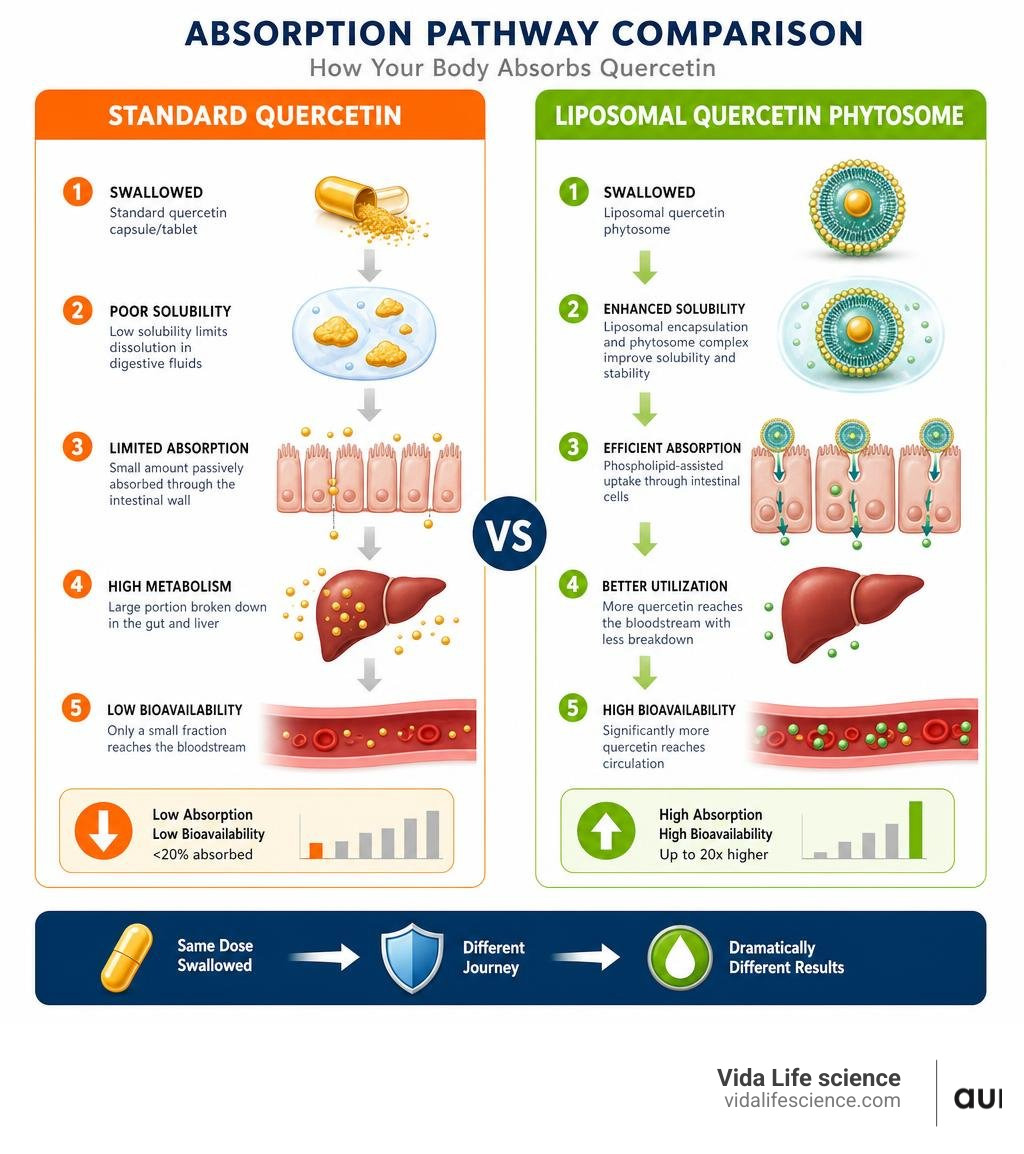
Standard quercetin supplements have a serious absorption problem. Most of what you swallow never makes it into your bloodstream. Poor water solubility, rapid breakdown in the gut, and heavy metabolism by liver enzymes mean a 500 mg capsule might only deliver a fraction of its dose where it actually matters.
You could be taking quercetin every day and still not reaching the blood levels needed to see results.
That's why enhanced delivery forms like liposomal and phytosome quercetin were developed — and why the difference between supplement forms is far from trivial.
At Vida Life Science, we specialize in phosphatidylcholine-based liposomal nutrient delivery technology through our exclusive partnership with Aurora Nutrascience, giving us deep expertise in exactly how liposomal quercetin phytosome formulations work at the molecular level. That foundation informs everything we share in this guide.
The Bioavailability Challenge of Standard Quercetin
To understand why we need advanced delivery systems, we first have to look at what happens when you swallow standard quercetin dihydrate (the most common form found in basic supplements).
Standard quercetin is highly hydrophobic, meaning it does not dissolve well in water. In fact, its water solubility is a measly 0.01 mg/ml. When a substance cannot dissolve in the watery environment of your digestive tract, your body cannot easily transport it across the intestinal lining.
To make matters worse, standard quercetin is highly unstable in the gastrointestinal tract. Once swallowed, it is subjected to harsh stomach acids and then rapidly metabolized by your gut bacteria and liver enzymes. This process—known as first-pass metabolism—involves glucuronidation, sulfation, and methylation. By the time quercetin enters your systemic circulation, it has been heavily altered into metabolites like quercetin-3-O-β-d-glucuronide (Q3GA), leaving very little free, active quercetin to circulate to your cells.
In clinical terms, standard quercetin absorbs at a rate of less than 20%, with some studies suggesting the actual intact absorption is in the single digits. This means that even if you take a massive 1,000 mg dose of standard quercetin, your cells only receive a tiny fraction of that amount.
| Parameter |
Standard Quercetin Dihydrate |
Enhanced Phytosome/Liposomal Delivery |
| Water Solubility |
Extremely poor (~0.01 mg/ml) |
Significantly improved via lipid complexing |
| Intestinal Fluid Solubility (FeSSIF pH 5.0) |
0.0191 mg/ml |
0.2166 mg/ml (over 11-fold increase) |
| First-Pass Metabolism |
High; heavily degraded by gut and liver |
Protected; bypasses early enzymatic breakdown |
| Microbiome Dependency |
Highly dependent on individual gut flora |
Partially bypasses gut bacterial degradation |
| Plasma Half-Life |
Short; cleared rapidly |
Extended; sustained release over time |
Understanding the Science of Liposomal Quercetin Phytosome
To solve these absorption barriers, supplement manufacturers have turned to the power of plant-derived lipids. By combining quercetin with phospholipids—specifically phosphatidylcholine sourced from sunflower lecithin—we can create delivery systems that behave like natural cell membranes.
These lipid-based systems act as a "cellular VIP pass," allowing the quercetin to slip through the digestive barrier and directly into your bloodstream and lymphatic system.
What is Liposomal Quercetin Phytosome?
Typically sourced from the flowers of the Sophora japonica (Japanese pagoda tree), liposomal quercetin phytosome represents a hybrid approach to nutrient delivery.
In standard supplements, you might find either a pure liposome or a pure phytosome. A hybrid liposomal quercetin phytosome formulation leverages the molecular bonding of a phytosome alongside the protective, water-soluble outer shell of a liposome. This dual-action structure ensures that the quercetin is both highly soluble in digestive fluids and exceptionally stable as it travels through your body.
How Phytosomes and Liposomes Work at the Molecular Level
While they sound similar, liposomes and phytosomes are structured differently at the molecular level:
-
Phytosome Technology: In a phytosome, the active plant compound (quercetin) is chemically bonded to the polar head of a phospholipid (such as phosphatidylcholine) at a molecular level, typically in a 1:1 ratio. This creates a homogeneous physical complex where the nutrient and the lipid move as a single molecule. Because the quercetin is anchored to the lipid, it inherits the lipid's fat-soluble properties, allowing it to easily cross lipid-rich cell membranes.
-
Liposomal Encapsulation: A liposome is a microscopic spherical vesicle. It features an outer double layer of phospholipids (a lipid bilayer) surrounding an inner aqueous core. In a classic liposome, water-soluble nutrients are held in the hydrophilic center, while fat-soluble nutrients sit nestled inside the hydrophobic tails of the lipid bilayer.
When these technologies are combined, the molecularly bonded quercetin-phytosome complex is encapsulated within a protective liposomal sphere. This structure mimics your body’s own cell membranes, protecting the delicate flavonoid from stomach acid and digestive enzymes while delivering it directly to the small intestine for rapid, efficient absorption.
Clinical Evidence and Pharmacokinetics of Enhanced Quercetin
The differences between standard quercetin and enhanced lipid-based formulations aren't just theoretical—they are backed by rigorous clinical data.
A landmark human pharmacokinetic crossover study evaluated the absorption of a standardized Quercetin Phytosome formulation compared to standard unformulated quercetin in healthy volunteers. The results were staggering:
-
Cmax (Peak Blood Concentration): A 500 mg dose of standard unformulated quercetin resulted in a peak plasma concentration (Cmax) of just 10.93 ± 2.22 ng/ml. In contrast, a 500 mg dose of Quercetin Phytosome achieved a Cmax of 223.10 ± 16.32 ng/ml—which is approximately 20 times higher than the standard form.
-
AUC (Total Exposure over Time): The Area Under the Curve (AUC), which measures the total amount of a nutrient that actually reaches systemic circulation, was 18-fold larger for the phytosome form compared to standard quercetin.
-
Faster Uptake (Tmax): The time to reach peak concentration (Tmax) was significantly shorter for the phytosome form (around 202 minutes) compared to unformulated quercetin (290 minutes), showing that the body absorbs the complex much faster.
-
Linear Dose-Dependency: The study also tested a lower 250 mg dose of the phytosome formulation, which yielded roughly half the Cmax and AUC of the 500 mg dose. This demonstrates a predictable, dose-dependent absorption pattern, allowing for precise therapeutic dosing.
Beyond absorption, clinical trials have shown that this enhanced bioavailability translates directly into better health outcomes. For example, a randomized controlled trial found that administering 1,000 mg of Quercetin Phytosome daily to patients with respiratory conditions significantly reduced hospitalization times and improved overall clinical recovery compared to those receiving standard care alone.
To experience these benefits firsthand, it is essential to choose high-quality, scientifically verified liposomal quercetin phytosome supplements that guarantee this level of cellular delivery.
Practical Applications: Dosage, Timing, and Synergy
Because enhanced delivery forms are absorbed so much better, you do not need to take massive doses to achieve therapeutic blood levels. Understanding how to dose and pair your supplement can maximize its systemic benefits.
To learn more about how lipid-based encapsulation protects nutrients from degradation, you can explore our detailed guide on liposomal delivery systems.
Optimal Dosage and Timing for Liposomal Quercetin Phytosome
-
Dosage: While standard, unformulated quercetin is typically dosed at 500 mg to 1,000 mg per day, liposomal quercetin phytosome is highly effective at much lower doses. A daily dose of 250 mg to 500 mg is generally recommended for daily immune support, allergy management, and antioxidant protection.
-
Timing: For best results, take your supplement consistently at the same time each day. While liposomal and phytosome forms are designed to bypass the strict requirement of being taken with dietary fats, taking your supplement alongside a meal containing healthy fats (like avocado, olive oil, or nuts) can still support natural biliary pathways and enhance overall absorption.
-
Consistency: Unlike some supplements that can be taken sporadically, quercetin's benefits accumulate over time as plasma levels stabilize in your blood. Daily, consistent use is key.
Synergistic Nutrients: Vitamin C, Bromelain, and Zinc
Quercetin works best when paired with complementary nutrients that enhance its mechanism of action:
-
Vitamin C: Vitamin C has a recycling effect on quercetin. When quercetin neutralizes a free radical, it becomes oxidized (spent). Vitamin C acts as a reducing agent, donating an electron to regenerate the quercetin back into its active, antioxidant state.
-
Bromelain: Often paired with quercetin in respiratory and allergy formulas, bromelain is a protein-digesting enzyme derived from pineapples. It helps reduce tissue swelling and inflammation, working synergistically with quercetin to soothe overactive immune responses.
-
Zinc: Quercetin acts as a natural zinc ionophore. Zinc is a powerful mineral for immune defense, but it has difficulty crossing lipid cell membranes on its own. Quercetin binds to zinc and escorts it across the cell membrane into the cytoplasm, where zinc can actively inhibit viral replication and support cellular health.
Who Benefits Most and Safety Considerations
Enhanced quercetin is an incredibly versatile tool for systemic health, but certain individuals will find it particularly beneficial:
-
Allergy and Asthma Sufferers: Quercetin is a natural mast cell stabilizer. It helps inhibit the release of histamine—the chemical responsible for runny noses, itchy eyes, and sneezing.
-
Aging Adults (Senolytic Support): In the field of longevity science, quercetin is recognized as a potent senolytic. It selectively helps your body clear out "senescent cells" (damaged cells that refuse to die and instead secrete inflammatory signals), supporting healthy tissue regeneration.
-
Cardiovascular Support: By helping to manage oxidative stress and supporting nitric oxide production, quercetin promotes healthy blood vessel dilation and arterial elasticity.
Safety and Contraindications
While liposomal quercetin phytosome has an excellent safety profile, there are several precautions to keep in mind:
-
Drug Interactions (CYP3A4 Inhibition): Quercetin is a known inhibitor of the cytochrome P450 enzyme CYP3A4. This liver enzyme is responsible for metabolizing many common medications, including statins, calcium channel blockers, and certain immunosuppressants. If you take medications metabolized by this pathway, consult your doctor first, as quercetin could increase the concentration of these drugs in your blood.
-
Kidney Disease: High doses of standard quercetin have occasionally been linked to renal strain. While enhanced forms require much lower doses, individuals with pre-existing kidney disease should exercise caution.
-
Pregnancy and Breastfeeding: Due to a lack of safety data in pregnant or lactating women, avoid supplemental quercetin during these periods unless specifically advised by a healthcare provider.
How to Track If Your Quercetin Supplement Is Working
You shouldn't have to guess whether your supplement is doing its job. Instead of relying purely on subjective feelings, you can use objective biomarker testing to track changes in your systemic inflammation and oxidative stress levels.
Before starting your supplement regimen, consider ordering a baseline blood panel, and then re-test after 8 to 12 weeks of consistent daily use. Key biomarkers to monitor include:
-
High-Sensitivity C-Reactive Protein (hs-CRP): This is the gold standard marker for systemic, low-grade inflammation. Levels above 3.0 mg/L indicate elevated cardiovascular and inflammatory risk. A successful anti-inflammatory protocol should show a downward trend in hs-CRP.
-
Ferritin: While commonly known as an iron storage marker, ferritin is also an acute-phase reactant. High levels of ferritin can indicate systemic inflammation and oxidative stress.
-
Erythrocyte Sedimentation Rate (ESR): This test measures how quickly red blood cells settle at the bottom of a test tube. A faster rate indicates higher systemic inflammation.
-
Uric Acid: Quercetin naturally inhibits xanthine oxidase, the enzyme responsible for producing uric acid. Tracking uric acid can be highly useful, especially for those managing joint discomfort.
Frequently Asked Questions about Quercetin Absorption
What is the difference between liposomal and phytosome quercetin?
A phytosome involves a direct molecular bond where the quercetin is physically attached to the polar head of a phospholipid (like lecithin). A liposome is a larger, double-layered lipid bubble that encapsulates nutrients within its core or lipid walls. Hybrid liposomal quercetin phytosome formulas combine both technologies, bonding the molecule for membrane compatibility and wrapping it in a protective lipid bilayer for maximum stability.
Why does standard quercetin have such low bioavailability?
Standard quercetin has extremely poor water solubility (hydrophobic properties) and is highly unstable in the digestive tract. It is rapidly broken down by stomach acid, metabolized by gut bacteria, and heavily processed by liver enzymes during first-pass metabolism, leaving very little active compound to reach your cells.
Can I take liposomal quercetin phytosome daily?
Yes. Daily, consistent supplementation is highly recommended because quercetin's therapeutic benefits rely on building and maintaining stable plasma levels in your bloodstream over time. Clinical studies have shown that daily doses of up to 1,000 mg of formulated quercetin are safe and well-tolerated for up to 12 weeks. Always consult your physician for long-term daily use beyond this window.
Conclusion
Standard quercetin supplements are severely limited by poor solubility and rapid degradation in your digestive tract. By utilizing advanced lipid-based complexes, liposomal quercetin phytosome overcomes these biological barriers, achieving up to 20 times higher blood concentrations than standard forms.
At Vida Life Science, we are proud to be the exclusive distributor of Aurora Nutrascience liposomal supplements across the USA and Canada. By leveraging cutting-edge, phosphatidylcholine-based liposome delivery technology, we ensure that your nutrients bypass digestive degradation and reach your cells exactly when and where they are needed most.
Ready to experience the power of highly bioavailable clinical nutrition? Discover More info about advanced nutrient absorption and find the perfect formulation to support your health journey today.


Phytosome vs. Liposome: Demystifying Liposomal Quercetin Phytosome
Why Quercetin's Absorption Problem Changes Everything
Liposomal quercetin phytosome is a next-generation supplement that combines two advanced delivery technologies — liposomal encapsulation and phytosome complexing — to dramatically improve how quercetin is absorbed by your body.
Here's the quick answer if you're short on time:
Quercetin is one of the most studied flavonoids in nature. It's found in apples, onions, berries, and green tea. Research links it to antioxidant protection, reduced inflammation, immune support, and even healthy aging.
But there's a catch.
Standard quercetin supplements have a serious absorption problem. Most of what you swallow never makes it into your bloodstream. Poor water solubility, rapid breakdown in the gut, and heavy metabolism by liver enzymes mean a 500 mg capsule might only deliver a fraction of its dose where it actually matters.
You could be taking quercetin every day and still not reaching the blood levels needed to see results.
That's why enhanced delivery forms like liposomal and phytosome quercetin were developed — and why the difference between supplement forms is far from trivial.
At Vida Life Science, we specialize in phosphatidylcholine-based liposomal nutrient delivery technology through our exclusive partnership with Aurora Nutrascience, giving us deep expertise in exactly how liposomal quercetin phytosome formulations work at the molecular level. That foundation informs everything we share in this guide.
The Bioavailability Challenge of Standard Quercetin
To understand why we need advanced delivery systems, we first have to look at what happens when you swallow standard quercetin dihydrate (the most common form found in basic supplements).
Standard quercetin is highly hydrophobic, meaning it does not dissolve well in water. In fact, its water solubility is a measly 0.01 mg/ml. When a substance cannot dissolve in the watery environment of your digestive tract, your body cannot easily transport it across the intestinal lining.
To make matters worse, standard quercetin is highly unstable in the gastrointestinal tract. Once swallowed, it is subjected to harsh stomach acids and then rapidly metabolized by your gut bacteria and liver enzymes. This process—known as first-pass metabolism—involves glucuronidation, sulfation, and methylation. By the time quercetin enters your systemic circulation, it has been heavily altered into metabolites like quercetin-3-O-β-d-glucuronide (Q3GA), leaving very little free, active quercetin to circulate to your cells.
In clinical terms, standard quercetin absorbs at a rate of less than 20%, with some studies suggesting the actual intact absorption is in the single digits. This means that even if you take a massive 1,000 mg dose of standard quercetin, your cells only receive a tiny fraction of that amount.
Understanding the Science of Liposomal Quercetin Phytosome
To solve these absorption barriers, supplement manufacturers have turned to the power of plant-derived lipids. By combining quercetin with phospholipids—specifically phosphatidylcholine sourced from sunflower lecithin—we can create delivery systems that behave like natural cell membranes.
These lipid-based systems act as a "cellular VIP pass," allowing the quercetin to slip through the digestive barrier and directly into your bloodstream and lymphatic system.
What is Liposomal Quercetin Phytosome?
Typically sourced from the flowers of the Sophora japonica (Japanese pagoda tree), liposomal quercetin phytosome represents a hybrid approach to nutrient delivery.
In standard supplements, you might find either a pure liposome or a pure phytosome. A hybrid liposomal quercetin phytosome formulation leverages the molecular bonding of a phytosome alongside the protective, water-soluble outer shell of a liposome. This dual-action structure ensures that the quercetin is both highly soluble in digestive fluids and exceptionally stable as it travels through your body.
How Phytosomes and Liposomes Work at the Molecular Level
While they sound similar, liposomes and phytosomes are structured differently at the molecular level:
When these technologies are combined, the molecularly bonded quercetin-phytosome complex is encapsulated within a protective liposomal sphere. This structure mimics your body’s own cell membranes, protecting the delicate flavonoid from stomach acid and digestive enzymes while delivering it directly to the small intestine for rapid, efficient absorption.
Clinical Evidence and Pharmacokinetics of Enhanced Quercetin
The differences between standard quercetin and enhanced lipid-based formulations aren't just theoretical—they are backed by rigorous clinical data.
A landmark human pharmacokinetic crossover study evaluated the absorption of a standardized Quercetin Phytosome formulation compared to standard unformulated quercetin in healthy volunteers. The results were staggering:
Beyond absorption, clinical trials have shown that this enhanced bioavailability translates directly into better health outcomes. For example, a randomized controlled trial found that administering 1,000 mg of Quercetin Phytosome daily to patients with respiratory conditions significantly reduced hospitalization times and improved overall clinical recovery compared to those receiving standard care alone.
To experience these benefits firsthand, it is essential to choose high-quality, scientifically verified liposomal quercetin phytosome supplements that guarantee this level of cellular delivery.
Practical Applications: Dosage, Timing, and Synergy
Because enhanced delivery forms are absorbed so much better, you do not need to take massive doses to achieve therapeutic blood levels. Understanding how to dose and pair your supplement can maximize its systemic benefits.
To learn more about how lipid-based encapsulation protects nutrients from degradation, you can explore our detailed guide on liposomal delivery systems.
Optimal Dosage and Timing for Liposomal Quercetin Phytosome
Synergistic Nutrients: Vitamin C, Bromelain, and Zinc
Quercetin works best when paired with complementary nutrients that enhance its mechanism of action:
Who Benefits Most and Safety Considerations
Enhanced quercetin is an incredibly versatile tool for systemic health, but certain individuals will find it particularly beneficial:
Safety and Contraindications
While liposomal quercetin phytosome has an excellent safety profile, there are several precautions to keep in mind:
How to Track If Your Quercetin Supplement Is Working
You shouldn't have to guess whether your supplement is doing its job. Instead of relying purely on subjective feelings, you can use objective biomarker testing to track changes in your systemic inflammation and oxidative stress levels.
Before starting your supplement regimen, consider ordering a baseline blood panel, and then re-test after 8 to 12 weeks of consistent daily use. Key biomarkers to monitor include:
Frequently Asked Questions about Quercetin Absorption
What is the difference between liposomal and phytosome quercetin?
A phytosome involves a direct molecular bond where the quercetin is physically attached to the polar head of a phospholipid (like lecithin). A liposome is a larger, double-layered lipid bubble that encapsulates nutrients within its core or lipid walls. Hybrid liposomal quercetin phytosome formulas combine both technologies, bonding the molecule for membrane compatibility and wrapping it in a protective lipid bilayer for maximum stability.
Why does standard quercetin have such low bioavailability?
Standard quercetin has extremely poor water solubility (hydrophobic properties) and is highly unstable in the digestive tract. It is rapidly broken down by stomach acid, metabolized by gut bacteria, and heavily processed by liver enzymes during first-pass metabolism, leaving very little active compound to reach your cells.
Can I take liposomal quercetin phytosome daily?
Yes. Daily, consistent supplementation is highly recommended because quercetin's therapeutic benefits rely on building and maintaining stable plasma levels in your bloodstream over time. Clinical studies have shown that daily doses of up to 1,000 mg of formulated quercetin are safe and well-tolerated for up to 12 weeks. Always consult your physician for long-term daily use beyond this window.
Conclusion
Standard quercetin supplements are severely limited by poor solubility and rapid degradation in your digestive tract. By utilizing advanced lipid-based complexes, liposomal quercetin phytosome overcomes these biological barriers, achieving up to 20 times higher blood concentrations than standard forms.
At Vida Life Science, we are proud to be the exclusive distributor of Aurora Nutrascience liposomal supplements across the USA and Canada. By leveraging cutting-edge, phosphatidylcholine-based liposome delivery technology, we ensure that your nutrients bypass digestive degradation and reach your cells exactly when and where they are needed most.
Ready to experience the power of highly bioavailable clinical nutrition? Discover More info about advanced nutrient absorption and find the perfect formulation to support your health journey today.