Does Vitamin C Help a Cold Go Away Faster? What Clinical Trials Show
Yes, vitamin C can help a cold go away faster, but the effect is modest and depends on consistent daily use rather than taking large doses only after symptoms begin. According to comprehensive data from a landmark Cochrane systematic review encompassing dozens of trials and over 11,000 participants, regular daily supplementation of at least 200 mg per day modestly reduces the overall duration of respiratory infections (Hemilä & Chalker, 2013).
For decades, vitamin C has held legendary status in medicine cabinets across the United States and Canada. Nobel laureate Linus Pauling popularized the idea of megadosing ascorbic acid in the 1970s, turning a simple citrus nutrient into an international immune-defense icon. But when modern clinical researchers evaluated these claims under strict double-blind conditions, they discovered a more nuanced reality.
When we look at the mathematical averages across randomized controlled trials, a standard cold lasting roughly seven days is shortened by approximately 8% in adults. In practical terms, that equates to shaving about 12 to 13 hours off your time spent sneezing into tissues. While half a day might not sound like a miracle cure, those extra symptom-free hours can make a meaningful difference when you are trying to get back to work, school, or daily life.
Importantly, the clinical trials highlight a fundamental distinction: prophylactic (daily preventive) use vs. reactive (post-onset) use. Taking a daily baseline of vitamin C prepares circulating leukocytes and tissue stores before viral exposure happens. In contrast, starting large doses only after your throat is scratchy and your nose is running yields inconsistent results in shortening the total illness duration.
How Does Vitamin C Help a Cold Go Away Faster in Adults vs Children?
One of the most intriguing findings from clinical literature is that pediatric immune systems respond more robustly to vitamin C supplementation than adult bodies. While adults experience an average duration reduction of 8%, children taking regular vitamin C see an average reduction of 14%.
Furthermore, when children receive slightly higher daily doses—ranging from 1 to 2 grams per day—clinical trials demonstrate a cold duration reduction of up to 18%. Because school-aged children catch an average of six to eight upper respiratory infections annually (amounting to roughly 28 illness days per year), an 18% reduction can spare a child nearly five full days of uncomfortable congestion and missed classroom time every single year.
| Population Subgroup |
Baseline Cold Days / Year |
Observed Duration Reduction |
Estimated Days Saved / Year |
|
General Adults (≥0.2 g/day) |
~12 days |
~8% shorter duration |
~1.0 day saved |
|
Children (≥0.2 g/day) |
~28 days |
~14% shorter duration |
~3.9 days saved |
|
Children (1–2 g/day) |
~28 days |
~18% shorter duration |
~5.0 days saved |
| Physically Stressed Adults |
Variable exposure |
~50% lower infection rate |
Up to half of potential colds prevented |
Why do young bodies see a greater benefit? Researchers believe this variance stems from differences in baseline dietary intake, metabolic rates, and the physiological demands of a rapidly maturing immune system. Because children are continuously building immune memory against common circulating rhinoviruses, adequate intracellular ascorbic acid provides essential cellular fuel during early immune recruitment.
Why Does Vitamin C Help a Cold Go Away Faster for Athletes Under Physical Stress?
While regular vitamin C does not prevent the average desk worker from catching a cold, there is a major clinical exception: people undergoing extreme, short-term physical exertion.
In trials examining marathon runners, skiers, and military personnel engaged in sub-arctic maneuvers, routine supplementation cut the incidence of common colds by roughly 50% (Relative Risk = 0.48).
Intense endurance training produces an enormous surge in reactive oxygen species (ROS) and elevated cortisol levels, creating a transient "open window" of immune suppression where viral pathogens easily take hold. Vitamin C serves as a potent physiological scavenger of these free radicals, neutralizing oxidative stress in circulating neutrophils and monocytes. For individuals challenging their physical limits in cold or demanding environments, consistent vitamin C intake acts as a cellular shield, keeping mucosal barriers intact and baseline defenses functioning optimally.
Impact on Cold Severity: Why Symptoms Feel Less Intense
Shortening the length of an illness is only half the battle; how terrible you feel while sick matters just as much. Recent systematic reviews have shifted attention from overall duration to symptom severity, yielding compelling discoveries.
A comprehensive meta-analysis published in BMC Public Health evaluated trials encompassing over 5,000 participants to determine whether vitamin C influences mild and severe symptoms equally. The findings were striking: vitamin C supplementation reduced overall cold severity by 15% (95% CI 9–21%).

More importantly, the research revealed a clear divergence between symptom grades:
-
Severe symptoms (days confined to bed, intense chills, high fever, and extreme fatigue) were reduced by 26%.
-
Mild symptoms (minor sniffles, localized tickles in the throat) showed no statistically significant change.
This explains why some historical trials concluded vitamin C had limited utility when they grouped all symptoms together. Vitamin C does not eliminate minor sniffles, but it effectively blunts the most debilitating phase of an upper respiratory infection. Trials evaluating workplace and school absenteeism confirm that participants taking supplemental vitamin C spent significantly fewer days confined indoors or bedridden. Additional meta-analyses examining adjunctive therapies corroborate that adding ascorbic acid improves clinical response markers and accelerates symptom relief (Ran et al., 2020).
Daily Prophylaxis vs Onset Dosing
To maximize immune resilience, timing is everything. Because ascorbic acid functions as a structural component in immune cells—concentrating inside white blood cells at levels up to 80 times higher than in plasma—maintaining intracellular saturation before an infection occurs is critical.
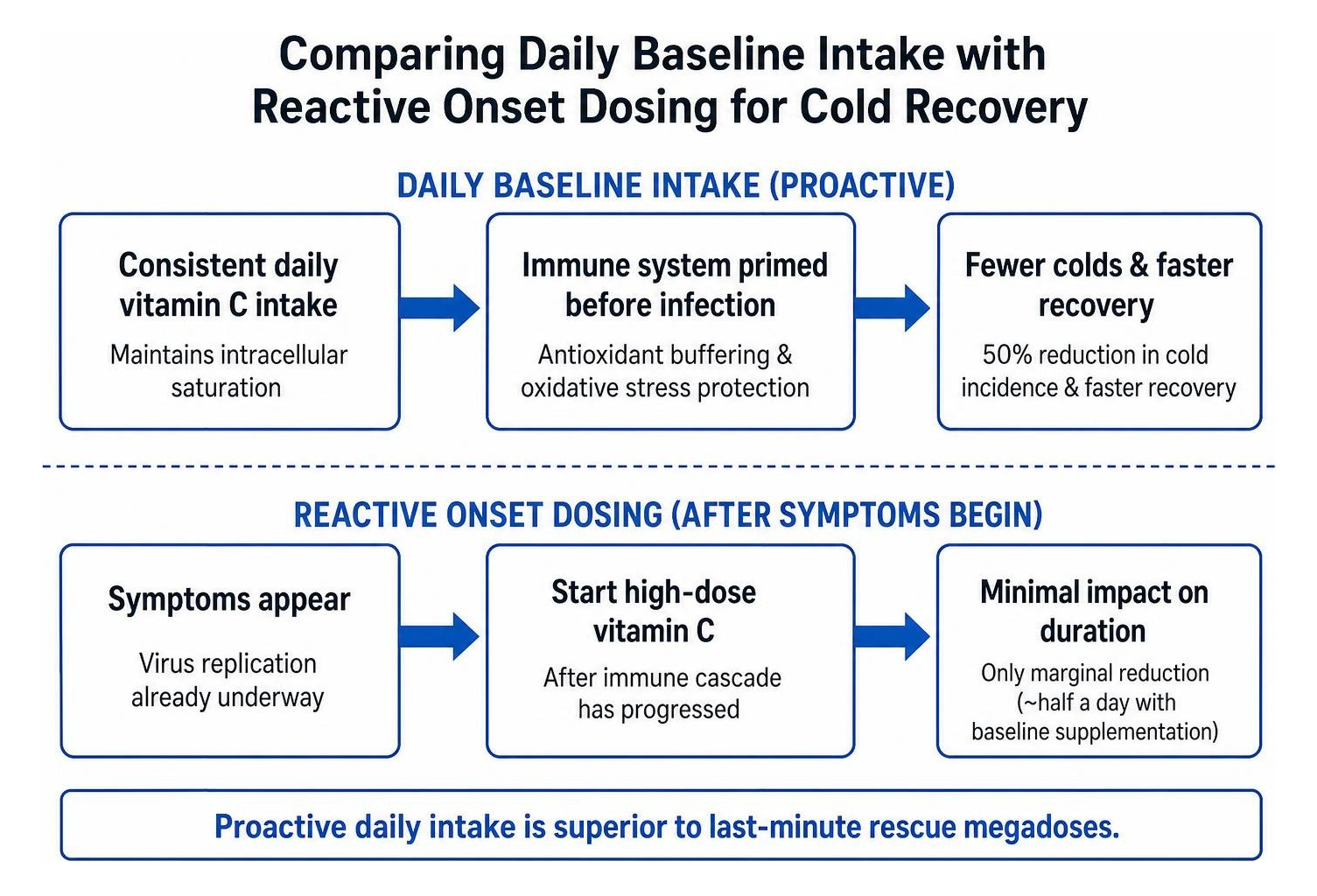
When you rely solely on reactive dosing (taking large amounts only after fever or nasal congestion sets in), the immune cascade has already progressed past its initial replication phase. Therapeutic trials examining high doses initiated strictly post-onset show only marginal reductions in mean illness duration (roughly half a day when combined with baseline supplementation).
To ensure your body maintains optimal defenses throughout the winter months, adopting a proactive cold and flu defense plan that pairs consistent daily antioxidant intake with healthy lifestyle habits is vastly superior to last-minute rescue megadoses.
Optimal Dosing, Bioavailability, and Safety Considerations
When it comes to oral vitamin C, human physiology has a built-in absorption threshold. Standard water-soluble ascorbic acid relies on specialized intestinal transport proteins known as sodium-dependent vitamin C transporters (SVCT-1).
At lower dietary doses (around 100 to 200 mg), intestinal absorption efficiency is high (70% to 90%). However, as single doses exceed 1,000 mg (1 gram), these transporter proteins become saturated. Unabsorbed ascorbic acid remains in the intestinal lumen, drawing in water through osmosis and causing uncomfortable side effects:
- Abdominal cramping and gas
- Osmotic diarrhea
- Nausea and gastrointestinal distress
- Increased urinary oxalate excretion, raising the risk of kidney stones in susceptible individuals
The established Tolerable Upper Intake Level (UL) for adults in North America is 2,000 mg per day, as outlined in clinical references like the MedlinePlus medical guidance. Exceeding this upper ceiling through traditional tablets often yields diminishing returns in blood levels while dramatically increasing the likelihood of digestive upset.
This physiological barrier is where advanced delivery formats change the equation. To bypass transporter saturation and avoid digestive irritation, liposomal encapsulation wraps ascorbic acid molecules in a protective phospholipid bilayer membrane. Understanding how absorption and bioavailability work reveals that liposomes can fuse directly with cell membranes in the digestive tract, facilitating gentle, superior cellular delivery without triggering osmotic loose stools.
Comparing Vitamin C to Other Immune Support Options
Vitamin C is a foundational micronutrient, but it does not operate in isolation within the human body. When evaluating evidence-based natural strategies for seasonal wellness, pairing complementary cellular antioxidants provides comprehensive immune support.
-
Glutathione: Known as the body's master antioxidant, glutathione works in a continuous recycling loop with ascorbic acid. Vitamin C neutralizes free radicals, while glutathione regenerates oxidized vitamin C back into its active form, sustaining cellular defenses during immune challenges.
-
Liposomal Delivery Systems: Encapsulating essential nutrients within protective phospholipid structures enhances nutrient absorption, bypassing digestive breakdown and ensuring optimal intracellular levels when seasonal wellness needs support.
For those looking to maintain peak seasonal wellness, exploring advanced liposomal immune support formulations ensures that these delicate antioxidant networks are delivered directly to cells with maximum biological efficacy.
Frequently Asked Questions About Vitamin C and Cold Recovery
Navigating supplement claims can be confusing. Below, we address common questions using clinical evidence and Mayo Clinic guidance to separate persistent health myths from biological facts.
Does taking vitamin C prevent catching a cold in the first place?
For the general population living typical lifestyles, taking daily vitamin C does not significantly lower your risk of catching an everyday viral cold. Large-scale clinical meta-analyses demonstrate a pooled relative risk ratio of roughly 0.97, meaning community incidence rates remain largely unchanged. The primary preventive exception applies to individuals facing severe physical stress, such as marathon runners or soldiers in freezing climates, where cold incidence is halved. For everyone else, daily vitamin C serves to shorten duration and lessen symptom severity once a bug strikes, rather than erecting an impenetrable viral barrier.
What is the maximum safe daily dose of vitamin C during an illness?
The established safe upper intake level for adults is 2,000 mg (2 grams) per day. While some individuals experiment with temporary higher intakes during acute infections, consuming more than 2,000 mg of conventional ascorbic acid at once frequently causes osmotic diarrhea, stomach cramps, and nausea as unabsorbed acid pulls water into the colon. If you choose to take divided doses throughout the day during an illness, staying at or below 1,000 to 2,000 mg ensures immune benefits without triggering digestive rebellion.
Should I consult a doctor before starting high-dose vitamin C?
Yes, particularly if you have underlying medical conditions. Individuals with a history of calcium oxalate kidney stones, hemochromatosis (iron overload disorder), or glucose-6-phosphate dehydrogenase (G6PD) deficiency must exercise caution with high-dose supplementation. Vitamin C significantly enhances non-heme iron absorption, which can complicate certain metabolic disorders. Consulting a licensed healthcare provider ensures your supplement routine complements your personal health profile and existing medications.
Conclusion
When evaluating whether vitamin C helps a cold go away faster, the science confirms that this essential antioxidant remains a valuable ally—provided expectations align with clinical realities. It is not an overnight cure that instantly erases viral infections, nor will an occasional glass of orange juice completely shield you from winter bugs.
Instead, consistent daily intake of 200 mg to 1,000 mg builds cellular antioxidant reserves that modestly shorten cold duration (by roughly 8% in adults and up to 18% in children) while reducing the severity of debilitating symptoms by over a quarter. For active individuals and athletes putting their bodies through strenuous exertion, the preventive defense is even more substantial.
At Vida Life Science, we are dedicated to providing the highest quality liposomal formulas manufactured by Aurora Nutrascience. By shielding delicate nutrients in biocompatible liposomes, our formulations ensure your body receives optimal absorption without intestinal discomfort. To support your family's seasonal wellness foundation, learn how you can boost your immune system with liposomal vitamin C and build a resilient health routine that lasts all year long.
References
Hemilä H, Chalker E. "Vitamin C for preventing and treating the common cold.." The Cochrane database of systematic reviews, 2013. PMCID PMC8078152. Ran L, Zhao W, Wang H, Zhao Y, Bu H. "Vitamin C as a Supplementary Therapy in Relieving Symptoms of the Common Cold: A Meta-Analysis of 10 Randomized Controlled Trials.." BioMed research international, 2020. PMCID PMC7569434.


The Cold Truth About Vitamin C and Recovery Speed
Does Vitamin C Help a Cold Go Away Faster? What Clinical Trials Show
Yes, vitamin C can help a cold go away faster, but the effect is modest and depends on consistent daily use rather than taking large doses only after symptoms begin. According to comprehensive data from a landmark Cochrane systematic review encompassing dozens of trials and over 11,000 participants, regular daily supplementation of at least 200 mg per day modestly reduces the overall duration of respiratory infections (Hemilä & Chalker, 2013).
For decades, vitamin C has held legendary status in medicine cabinets across the United States and Canada. Nobel laureate Linus Pauling popularized the idea of megadosing ascorbic acid in the 1970s, turning a simple citrus nutrient into an international immune-defense icon. But when modern clinical researchers evaluated these claims under strict double-blind conditions, they discovered a more nuanced reality.
When we look at the mathematical averages across randomized controlled trials, a standard cold lasting roughly seven days is shortened by approximately 8% in adults. In practical terms, that equates to shaving about 12 to 13 hours off your time spent sneezing into tissues. While half a day might not sound like a miracle cure, those extra symptom-free hours can make a meaningful difference when you are trying to get back to work, school, or daily life.
Importantly, the clinical trials highlight a fundamental distinction: prophylactic (daily preventive) use vs. reactive (post-onset) use. Taking a daily baseline of vitamin C prepares circulating leukocytes and tissue stores before viral exposure happens. In contrast, starting large doses only after your throat is scratchy and your nose is running yields inconsistent results in shortening the total illness duration.
How Does Vitamin C Help a Cold Go Away Faster in Adults vs Children?
One of the most intriguing findings from clinical literature is that pediatric immune systems respond more robustly to vitamin C supplementation than adult bodies. While adults experience an average duration reduction of 8%, children taking regular vitamin C see an average reduction of 14%.
Furthermore, when children receive slightly higher daily doses—ranging from 1 to 2 grams per day—clinical trials demonstrate a cold duration reduction of up to 18%. Because school-aged children catch an average of six to eight upper respiratory infections annually (amounting to roughly 28 illness days per year), an 18% reduction can spare a child nearly five full days of uncomfortable congestion and missed classroom time every single year.
Why do young bodies see a greater benefit? Researchers believe this variance stems from differences in baseline dietary intake, metabolic rates, and the physiological demands of a rapidly maturing immune system. Because children are continuously building immune memory against common circulating rhinoviruses, adequate intracellular ascorbic acid provides essential cellular fuel during early immune recruitment.
Why Does Vitamin C Help a Cold Go Away Faster for Athletes Under Physical Stress?
While regular vitamin C does not prevent the average desk worker from catching a cold, there is a major clinical exception: people undergoing extreme, short-term physical exertion.
In trials examining marathon runners, skiers, and military personnel engaged in sub-arctic maneuvers, routine supplementation cut the incidence of common colds by roughly 50% (Relative Risk = 0.48).
Intense endurance training produces an enormous surge in reactive oxygen species (ROS) and elevated cortisol levels, creating a transient "open window" of immune suppression where viral pathogens easily take hold. Vitamin C serves as a potent physiological scavenger of these free radicals, neutralizing oxidative stress in circulating neutrophils and monocytes. For individuals challenging their physical limits in cold or demanding environments, consistent vitamin C intake acts as a cellular shield, keeping mucosal barriers intact and baseline defenses functioning optimally.
Impact on Cold Severity: Why Symptoms Feel Less Intense
Shortening the length of an illness is only half the battle; how terrible you feel while sick matters just as much. Recent systematic reviews have shifted attention from overall duration to symptom severity, yielding compelling discoveries.
A comprehensive meta-analysis published in BMC Public Health evaluated trials encompassing over 5,000 participants to determine whether vitamin C influences mild and severe symptoms equally. The findings were striking: vitamin C supplementation reduced overall cold severity by 15% (95% CI 9–21%).
More importantly, the research revealed a clear divergence between symptom grades:
This explains why some historical trials concluded vitamin C had limited utility when they grouped all symptoms together. Vitamin C does not eliminate minor sniffles, but it effectively blunts the most debilitating phase of an upper respiratory infection. Trials evaluating workplace and school absenteeism confirm that participants taking supplemental vitamin C spent significantly fewer days confined indoors or bedridden. Additional meta-analyses examining adjunctive therapies corroborate that adding ascorbic acid improves clinical response markers and accelerates symptom relief (Ran et al., 2020).
Daily Prophylaxis vs Onset Dosing
To maximize immune resilience, timing is everything. Because ascorbic acid functions as a structural component in immune cells—concentrating inside white blood cells at levels up to 80 times higher than in plasma—maintaining intracellular saturation before an infection occurs is critical.
When you rely solely on reactive dosing (taking large amounts only after fever or nasal congestion sets in), the immune cascade has already progressed past its initial replication phase. Therapeutic trials examining high doses initiated strictly post-onset show only marginal reductions in mean illness duration (roughly half a day when combined with baseline supplementation).
To ensure your body maintains optimal defenses throughout the winter months, adopting a proactive cold and flu defense plan that pairs consistent daily antioxidant intake with healthy lifestyle habits is vastly superior to last-minute rescue megadoses.
Optimal Dosing, Bioavailability, and Safety Considerations
When it comes to oral vitamin C, human physiology has a built-in absorption threshold. Standard water-soluble ascorbic acid relies on specialized intestinal transport proteins known as sodium-dependent vitamin C transporters (SVCT-1).
At lower dietary doses (around 100 to 200 mg), intestinal absorption efficiency is high (70% to 90%). However, as single doses exceed 1,000 mg (1 gram), these transporter proteins become saturated. Unabsorbed ascorbic acid remains in the intestinal lumen, drawing in water through osmosis and causing uncomfortable side effects:
The established Tolerable Upper Intake Level (UL) for adults in North America is 2,000 mg per day, as outlined in clinical references like the MedlinePlus medical guidance. Exceeding this upper ceiling through traditional tablets often yields diminishing returns in blood levels while dramatically increasing the likelihood of digestive upset.
This physiological barrier is where advanced delivery formats change the equation. To bypass transporter saturation and avoid digestive irritation, liposomal encapsulation wraps ascorbic acid molecules in a protective phospholipid bilayer membrane. Understanding how absorption and bioavailability work reveals that liposomes can fuse directly with cell membranes in the digestive tract, facilitating gentle, superior cellular delivery without triggering osmotic loose stools.
Comparing Vitamin C to Other Immune Support Options
Vitamin C is a foundational micronutrient, but it does not operate in isolation within the human body. When evaluating evidence-based natural strategies for seasonal wellness, pairing complementary cellular antioxidants provides comprehensive immune support.
For those looking to maintain peak seasonal wellness, exploring advanced liposomal immune support formulations ensures that these delicate antioxidant networks are delivered directly to cells with maximum biological efficacy.
Frequently Asked Questions About Vitamin C and Cold Recovery
Navigating supplement claims can be confusing. Below, we address common questions using clinical evidence and Mayo Clinic guidance to separate persistent health myths from biological facts.
Does taking vitamin C prevent catching a cold in the first place?
For the general population living typical lifestyles, taking daily vitamin C does not significantly lower your risk of catching an everyday viral cold. Large-scale clinical meta-analyses demonstrate a pooled relative risk ratio of roughly 0.97, meaning community incidence rates remain largely unchanged. The primary preventive exception applies to individuals facing severe physical stress, such as marathon runners or soldiers in freezing climates, where cold incidence is halved. For everyone else, daily vitamin C serves to shorten duration and lessen symptom severity once a bug strikes, rather than erecting an impenetrable viral barrier.
What is the maximum safe daily dose of vitamin C during an illness?
The established safe upper intake level for adults is 2,000 mg (2 grams) per day. While some individuals experiment with temporary higher intakes during acute infections, consuming more than 2,000 mg of conventional ascorbic acid at once frequently causes osmotic diarrhea, stomach cramps, and nausea as unabsorbed acid pulls water into the colon. If you choose to take divided doses throughout the day during an illness, staying at or below 1,000 to 2,000 mg ensures immune benefits without triggering digestive rebellion.
Should I consult a doctor before starting high-dose vitamin C?
Yes, particularly if you have underlying medical conditions. Individuals with a history of calcium oxalate kidney stones, hemochromatosis (iron overload disorder), or glucose-6-phosphate dehydrogenase (G6PD) deficiency must exercise caution with high-dose supplementation. Vitamin C significantly enhances non-heme iron absorption, which can complicate certain metabolic disorders. Consulting a licensed healthcare provider ensures your supplement routine complements your personal health profile and existing medications.
Conclusion
When evaluating whether vitamin C helps a cold go away faster, the science confirms that this essential antioxidant remains a valuable ally—provided expectations align with clinical realities. It is not an overnight cure that instantly erases viral infections, nor will an occasional glass of orange juice completely shield you from winter bugs.
Instead, consistent daily intake of 200 mg to 1,000 mg builds cellular antioxidant reserves that modestly shorten cold duration (by roughly 8% in adults and up to 18% in children) while reducing the severity of debilitating symptoms by over a quarter. For active individuals and athletes putting their bodies through strenuous exertion, the preventive defense is even more substantial.
At Vida Life Science, we are dedicated to providing the highest quality liposomal formulas manufactured by Aurora Nutrascience. By shielding delicate nutrients in biocompatible liposomes, our formulations ensure your body receives optimal absorption without intestinal discomfort. To support your family's seasonal wellness foundation, learn how you can boost your immune system with liposomal vitamin C and build a resilient health routine that lasts all year long.
References
Hemilä H, Chalker E. "Vitamin C for preventing and treating the common cold.." The Cochrane database of systematic reviews, 2013. PMCID PMC8078152. Ran L, Zhao W, Wang H, Zhao Y, Bu H. "Vitamin C as a Supplementary Therapy in Relieving Symptoms of the Common Cold: A Meta-Analysis of 10 Randomized Controlled Trials.." BioMed research international, 2020. PMCID PMC7569434.