How to Choose the Best Prenatal Vitamins With CoQ10
The best prenatal vitamins with coq10 pair a clearly labeled CoQ10 dose with the basics of preconception care: folate, iron, iodine, vitamin D, and choline. Check whether DHA is included, too. If a prenatal meets your nutrient needs but leaves out CoQ10, ask your clinician whether a separate supplement makes sense while you are trying to conceive.
CoQ10 helps cells make energy, which is why researchers are studying its role in egg health. But it has not been proven to increase live birth rates, and pregnancy safety data are limited. Talk with your clinician about when to stop taking it if you become pregnant.
We are Vida Life Science, a distributor of liposomal supplements, including CoQ10, with experience helping people assess nutrient delivery and absorption. In this guide to the best prenatal vitamins with coq10, we will compare what is on the label with what matters for preconception care.

The Science of CoQ10: Why Egg Quality Depends on Cellular Energy
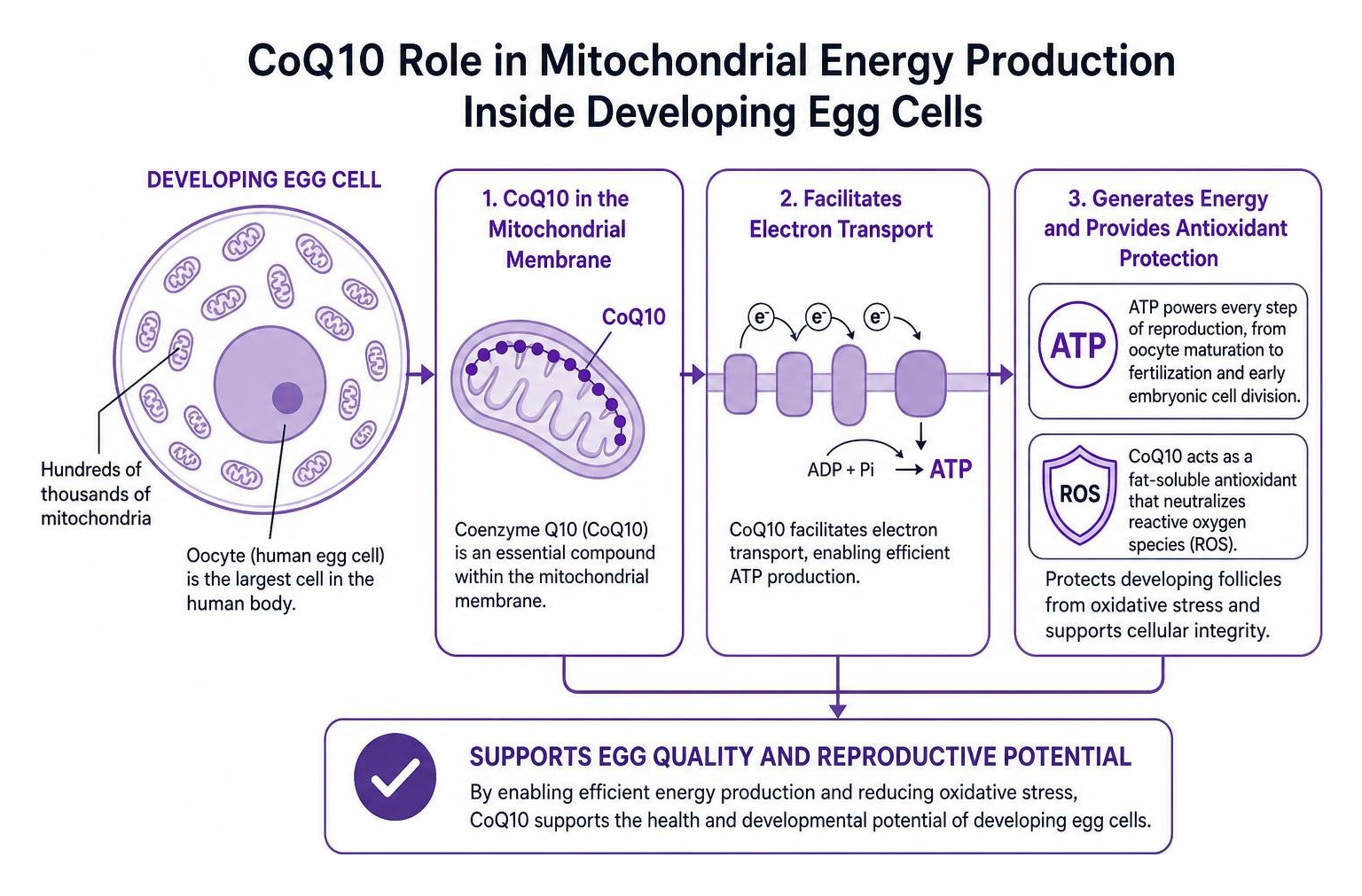
When preparing for pregnancy, most of the focus naturally falls on tracking ovulation and stocking up on traditional vitamins. However, biological reproduction begins at the cellular level. An oocyte (human egg cell) is the largest single cell in the human body, containing hundreds of thousands of mitochondria—far more than almost any other cell type.
Mitochondria function as cellular power plants, generating adenosine triphosphate (ATP) to drive every step of reproduction, from the final stages of oocyte maturation to fertilization and early embryonic cell division. Coenzyme Q10 (CoQ10) is an essential compound within the mitochondrial membrane that facilitates electron transport, enabling efficient ATP production while acting as a fat-soluble antioxidant.
As research into preconception nutrition expands, clinical investigations have highlighted how cellular bioenergetics impact fertility outcomes. Clinical reviews on fertility vitamins to take when trying to conceive consistently highlight CoQ10 alongside standard prenatal micronutrients. A 2023 study published in Human Fertility noted that CoQ10 supplementation improved ovarian response and increased both the quantity and quality of retrieved oocytes in women undergoing assisted reproductive technology (ART). Similarly, a 2018 study reported that CoQ10 was associated with increased oocyte yield, higher fertilization rates, and improved embryo quality in women experiencing diminished ovarian reserve.
Beyond cellular energy, CoQ10 provides vital antioxidant defense. Developing follicles are highly vulnerable to oxidative stress, which can damage intracellular structures and impair developmental potential. By neutralizing reactive oxygen species (ROS), CoQ10 protects cellular integrity during critical growth windows. For comprehensive preconception planning, exploring essential supplements for women helps ensure you are covering baseline micronutrient requirements while supporting cellular vitality.
A woman is born with all the eggs she will ever have. Over time, natural biological aging affects both ovarian reserve and cellular energy production. Inside older oocytes, mitochondrial function gradually declines, leading to reduced ATP production and an increase in oxidative stress. This bioenergetic deficit can impair the delicate machinery responsible for chromosome alignment and separation during cell division, increasing the likelihood of chromosomal aneuploidy (abnormal chromosome counts).
For women under 35, baseline mitochondrial activity is typically robust, though optimal nutrient intake remains critical for reproductive wellness. For women aged 35 and older, supporting mitochondrial bioenergetics becomes a standard clinical recommendation. Because cellular CoQ10 concentrations naturally decline with age, reproductive specialists frequently recommend targeted supplementation to help offset age-related energetic deficits in follicular fluid and developing oocytes.
Key Nutrients to Pair with the Best Prenatal Vitamins with CoQ10
While CoQ10 supports mitochondrial energy, a complete preconception regimen requires a balanced foundation of essential micronutrients. When building your routine, prioritize these evidence-backed nutrients:
-
Folate (as L-methylfolate): Crucial for neural tube development and cellular division. Methylated folate bypasses common genetic enzyme variations (such as MTHFR polymorphisms), ensuring efficient utilization. Aim for 400 to 800 mcg daily.
-
Iron: The American College of Obstetricians and Gynecologists (ACOG) recommends 27 mg daily during pregnancy to support increased maternal blood volume and oxygen delivery to developing tissues.
-
Choline: Critical for fetal neurodevelopment and placental function. Health organizations recommend approximately 450 mg daily, yet many standard prenatals contain less than 50 mg due to its bulk volume.
-
Omega-3 Fatty Acids (DHA & EPA): Long-chain omega-3s support fetal brain and retinal development while promoting healthy inflammatory balance. Aim for 300 to 1,000 mg of combined DHA/EPA.
-
Iodine: The American Thyroid Association recommends 150 mcg daily for women planning pregnancy or currently pregnant to support maternal and fetal thyroid hormone synthesis.
-
Vitamin D3: Promotes calcium absorption, immune health, and optimal ovarian physiology.
-
Selenium: An antioxidant mineral that works synergistically with CoQ10 to safeguard follicular health and thyroid metabolism.
Evaluating your daily intake helps prevent deficiencies before conception. For an in-depth look at identifying and correcting nutritional gaps, read our breakdown on most common vitamin deficiencies and how to address them.
What to Look for in the Best Prenatal Vitamins with CoQ10
Navigating the supplement aisle can be daunting, especially when marketing claims outpace scientific evidence. When evaluating preconception formulas, ingredient form, manufacturing standards, and clinical transparency are paramount.
Independent testing and rigorous manufacturing standards ensure that what is listed on the label matches what is inside the bottle. Look for brands that manufacture in cGMP-certified facilities and provide third-party verification for purity, potency, and the absence of heavy metals. Independent reviews evaluating the best fertility supplements to help you conceive frequently emphasize the importance of transparent labeling, bioavailable nutrient forms, and third-party quality control.
CoQ10 is naturally fat-soluble and possesses a relatively large molecular weight, making standard crystalline forms difficult for the digestive tract to absorb. Understanding the differences between available formats is essential:
-
Ubiquinone: The oxidized form of CoQ10. It is stable and widely studied in clinical trials, but requires conversion by the body into ubiquinol before acting as an active antioxidant. Absorption rates in standard dry capsules are typically low.
-
Ubiquinol: The reduced, active antioxidant form. It offers better baseline absorption than standard ubiquinone powder, though it remains fat-soluble and can degrade if exposed to air or heat.
-
Liposomal CoQ10: Advanced delivery systems that encapsulate CoQ10 inside microscopic lipid spheres (phospholipid bilayers). Because these liposomes mimic human cellular membranes, they shield the nutrient through stomach acid and facilitate direct uptake in the small intestine.
How to Identify the Best Prenatal Vitamins with CoQ10 for Maximum Absorption
To ensure optimal cellular uptake, look for formulations designed to enhance bioavailability:
-
Phospholipid Encapsulation: Genuine liposomal delivery structures encapsulate active molecules within non-GMO sunflower or soy lecithin phospholipids, protecting fragile nutrients from degradation in the digestive tract.
-
Liquid or Softgel Formats with Healthy Fats: Because CoQ10 is lipid-soluble, taking it alongside dietary fats or within oil-based suspensions improves mucosal transport compared to dry compressed tablets.
-
Formula Fit: Choose a format that aligns with your clinician's recommendations and the rest of your supplement routine.
For more information about CoQ10 and PQQ formulations, explore our high-potency CoQ10 PQQ options, which use liposomal delivery.
Building a Simple Preconception Supplement Plan
Start with one prenatal that fits your clinician's recommendations, then review its label for folate, iron, iodine, choline, vitamin D, and DHA. If you are considering CoQ10, note the form and amount separately so your care team can assess the full routine rather than one product in isolation.
Keep the plan manageable. A routine that is easy to follow consistently is usually more useful than adding multiple overlapping products. Bring your supplement list to preconception or fertility appointments, especially if you take prescription medications or are preparing for fertility treatment.
Timing, Safety, and Best Practices for Preconception CoQ10 Use
Maximizing the benefits of CoQ10 requires aligning your supplementation timeline with the biological timeline of egg development.
Folliculogenesis—the process by which a resting primordial follicle develops into a fully mature, ovulated egg—takes approximately 90 to 120 days. During these final three to four months, the developing oocyte experiences a surge in metabolic activity and mitochondrial replication. Consequently, beginning CoQ10 supplementation at least 3 to 6 months before trying to conceive (or starting an IVF cycle) yields the greatest physiological benefit.
Best practices for your preconception routine include:
-
Take CoQ10 with Meals: If using standard capsules, always consume them with a meal containing healthy fats (such as avocado, eggs, or olive oil) to assist absorption. Liposomal formulas can be taken with or without food.
-
Consistent Daily Dosing: Consistent intake over 90+ days maintains steady follicular fluid concentrations throughout the critical stages of egg maturation.
-
Discontinue Upon Positive Pregnancy Test: Because high-dose CoQ10 has not been evaluated in large-scale human pregnancy safety trials, clinical consensus recommends stopping CoQ10 once pregnancy is confirmed and transitioning to your regular prenatal vitamin.
-
Consult Your Physician: Always review your supplement regimen with your OB/GYN or reproductive endocrinologist, particularly if you are taking blood pressure medications or blood thinners.
Frequently Asked Questions About CoQ10 and Prenatals
Can I take CoQ10 throughout my entire pregnancy?
No, standard clinical guidance advises discontinuing CoQ10 supplementation once you receive a positive pregnancy test. While CoQ10 is naturally present in foods and human cells, clinical safety trials on high-dose therapeutic supplementation during human pregnancy are limited. Once conception occurs, mitochondrial demands shift toward gestational growth, and your foundational prenatal multivitamin (providing folate, iron, choline, iodine, and DHA) will cover all developmental requirements.
What is the recommended daily dosage of CoQ10 for fertility?
For preconception support and egg quality, reproductive endocrinologists commonly recommend dosages ranging from 200 mg to 600 mg daily of standard ubiquinone, or 100 mg to 300 mg daily of ubiquinol or high-absorption liposomal CoQ10. Because advanced liposomal formulations bypass typical gastrointestinal breakdown, lower daily doses often achieve systemic blood concentrations equivalent to much higher doses of unformulated dry powders. Always follow the personalized dosage recommendations provided by your fertility care team.
Can men also take CoQ10 while trying to conceive?
Yes, CoQ10 is frequently recommended for male partners during the preconception window. Sperm cells require significant cellular energy for forward motility, and their membranes are rich in polyunsaturated fatty acids that are vulnerable to oxidative damage. A 2020 clinical study and a 2021 reproductive review found that CoQ10 supplementation supported healthy sperm concentration, motility, and overall morphology by reducing seminal oxidative stress. Men should ideally begin supplementing 3 months prior to trying to conceive to support the full 74-day spermatogenesis cycle.
Conclusion
Preconception planning works best when it starts with the essentials: a well-formulated prenatal, a balanced diet, and guidance from a qualified clinician. CoQ10 is one option to discuss when egg health and nutrient delivery are part of the conversation.
Compare labels for folate, iron, iodine, choline, vitamin D, and DHA, then ask your care team whether CoQ10 is appropriate before conception. For additional background, read our comprehensive guide to CoQ10 supplementation.


Prenatal Power: Top CoQ10 Prenatals to Support Your Reproductive Health
How to Choose the Best Prenatal Vitamins With CoQ10
The best prenatal vitamins with coq10 pair a clearly labeled CoQ10 dose with the basics of preconception care: folate, iron, iodine, vitamin D, and choline. Check whether DHA is included, too. If a prenatal meets your nutrient needs but leaves out CoQ10, ask your clinician whether a separate supplement makes sense while you are trying to conceive.
CoQ10 helps cells make energy, which is why researchers are studying its role in egg health. But it has not been proven to increase live birth rates, and pregnancy safety data are limited. Talk with your clinician about when to stop taking it if you become pregnant.
We are Vida Life Science, a distributor of liposomal supplements, including CoQ10, with experience helping people assess nutrient delivery and absorption. In this guide to the best prenatal vitamins with coq10, we will compare what is on the label with what matters for preconception care.
The Science of CoQ10: Why Egg Quality Depends on Cellular Energy
When preparing for pregnancy, most of the focus naturally falls on tracking ovulation and stocking up on traditional vitamins. However, biological reproduction begins at the cellular level. An oocyte (human egg cell) is the largest single cell in the human body, containing hundreds of thousands of mitochondria—far more than almost any other cell type.
Mitochondria function as cellular power plants, generating adenosine triphosphate (ATP) to drive every step of reproduction, from the final stages of oocyte maturation to fertilization and early embryonic cell division. Coenzyme Q10 (CoQ10) is an essential compound within the mitochondrial membrane that facilitates electron transport, enabling efficient ATP production while acting as a fat-soluble antioxidant.
As research into preconception nutrition expands, clinical investigations have highlighted how cellular bioenergetics impact fertility outcomes. Clinical reviews on fertility vitamins to take when trying to conceive consistently highlight CoQ10 alongside standard prenatal micronutrients. A 2023 study published in Human Fertility noted that CoQ10 supplementation improved ovarian response and increased both the quantity and quality of retrieved oocytes in women undergoing assisted reproductive technology (ART). Similarly, a 2018 study reported that CoQ10 was associated with increased oocyte yield, higher fertilization rates, and improved embryo quality in women experiencing diminished ovarian reserve.
Beyond cellular energy, CoQ10 provides vital antioxidant defense. Developing follicles are highly vulnerable to oxidative stress, which can damage intracellular structures and impair developmental potential. By neutralizing reactive oxygen species (ROS), CoQ10 protects cellular integrity during critical growth windows. For comprehensive preconception planning, exploring essential supplements for women helps ensure you are covering baseline micronutrient requirements while supporting cellular vitality.
Age-Related Egg Decline: Under 35 vs. Over 35
A woman is born with all the eggs she will ever have. Over time, natural biological aging affects both ovarian reserve and cellular energy production. Inside older oocytes, mitochondrial function gradually declines, leading to reduced ATP production and an increase in oxidative stress. This bioenergetic deficit can impair the delicate machinery responsible for chromosome alignment and separation during cell division, increasing the likelihood of chromosomal aneuploidy (abnormal chromosome counts).
For women under 35, baseline mitochondrial activity is typically robust, though optimal nutrient intake remains critical for reproductive wellness. For women aged 35 and older, supporting mitochondrial bioenergetics becomes a standard clinical recommendation. Because cellular CoQ10 concentrations naturally decline with age, reproductive specialists frequently recommend targeted supplementation to help offset age-related energetic deficits in follicular fluid and developing oocytes.
Key Nutrients to Pair with the Best Prenatal Vitamins with CoQ10
While CoQ10 supports mitochondrial energy, a complete preconception regimen requires a balanced foundation of essential micronutrients. When building your routine, prioritize these evidence-backed nutrients:
Evaluating your daily intake helps prevent deficiencies before conception. For an in-depth look at identifying and correcting nutritional gaps, read our breakdown on most common vitamin deficiencies and how to address them.
What to Look for in the Best Prenatal Vitamins with CoQ10
Navigating the supplement aisle can be daunting, especially when marketing claims outpace scientific evidence. When evaluating preconception formulas, ingredient form, manufacturing standards, and clinical transparency are paramount.
Independent testing and rigorous manufacturing standards ensure that what is listed on the label matches what is inside the bottle. Look for brands that manufacture in cGMP-certified facilities and provide third-party verification for purity, potency, and the absence of heavy metals. Independent reviews evaluating the best fertility supplements to help you conceive frequently emphasize the importance of transparent labeling, bioavailable nutrient forms, and third-party quality control.
Ubiquinone vs. Ubiquinol vs. Liposomal Formulations
CoQ10 is naturally fat-soluble and possesses a relatively large molecular weight, making standard crystalline forms difficult for the digestive tract to absorb. Understanding the differences between available formats is essential:
How to Identify the Best Prenatal Vitamins with CoQ10 for Maximum Absorption
To ensure optimal cellular uptake, look for formulations designed to enhance bioavailability:
For more information about CoQ10 and PQQ formulations, explore our high-potency CoQ10 PQQ options, which use liposomal delivery.
Building a Simple Preconception Supplement Plan
Start with one prenatal that fits your clinician's recommendations, then review its label for folate, iron, iodine, choline, vitamin D, and DHA. If you are considering CoQ10, note the form and amount separately so your care team can assess the full routine rather than one product in isolation.
Keep the plan manageable. A routine that is easy to follow consistently is usually more useful than adding multiple overlapping products. Bring your supplement list to preconception or fertility appointments, especially if you take prescription medications or are preparing for fertility treatment.
Timing, Safety, and Best Practices for Preconception CoQ10 Use
Maximizing the benefits of CoQ10 requires aligning your supplementation timeline with the biological timeline of egg development.
Folliculogenesis—the process by which a resting primordial follicle develops into a fully mature, ovulated egg—takes approximately 90 to 120 days. During these final three to four months, the developing oocyte experiences a surge in metabolic activity and mitochondrial replication. Consequently, beginning CoQ10 supplementation at least 3 to 6 months before trying to conceive (or starting an IVF cycle) yields the greatest physiological benefit.
Best practices for your preconception routine include:
Frequently Asked Questions About CoQ10 and Prenatals
Can I take CoQ10 throughout my entire pregnancy?
No, standard clinical guidance advises discontinuing CoQ10 supplementation once you receive a positive pregnancy test. While CoQ10 is naturally present in foods and human cells, clinical safety trials on high-dose therapeutic supplementation during human pregnancy are limited. Once conception occurs, mitochondrial demands shift toward gestational growth, and your foundational prenatal multivitamin (providing folate, iron, choline, iodine, and DHA) will cover all developmental requirements.
What is the recommended daily dosage of CoQ10 for fertility?
For preconception support and egg quality, reproductive endocrinologists commonly recommend dosages ranging from 200 mg to 600 mg daily of standard ubiquinone, or 100 mg to 300 mg daily of ubiquinol or high-absorption liposomal CoQ10. Because advanced liposomal formulations bypass typical gastrointestinal breakdown, lower daily doses often achieve systemic blood concentrations equivalent to much higher doses of unformulated dry powders. Always follow the personalized dosage recommendations provided by your fertility care team.
Can men also take CoQ10 while trying to conceive?
Yes, CoQ10 is frequently recommended for male partners during the preconception window. Sperm cells require significant cellular energy for forward motility, and their membranes are rich in polyunsaturated fatty acids that are vulnerable to oxidative damage. A 2020 clinical study and a 2021 reproductive review found that CoQ10 supplementation supported healthy sperm concentration, motility, and overall morphology by reducing seminal oxidative stress. Men should ideally begin supplementing 3 months prior to trying to conceive to support the full 74-day spermatogenesis cycle.
Conclusion
Preconception planning works best when it starts with the essentials: a well-formulated prenatal, a balanced diet, and guidance from a qualified clinician. CoQ10 is one option to discuss when egg health and nutrient delivery are part of the conversation.
Compare labels for folate, iron, iodine, choline, vitamin D, and DHA, then ask your care team whether CoQ10 is appropriate before conception. For additional background, read our comprehensive guide to CoQ10 supplementation.